

















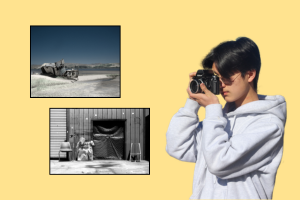
On a plane thousands of feet in the air, junior Ayden Jeong captures the view outside with a click of his camera shutter: Utah’s Great Salt Lake and the surrounding desert. In the darkroom, he winds a roll of film, anticipating how the scene will look once developed. For Jeong, photography is a way to capture moments in time, turning ordinary sights into objects worth physically holding onto.
Jeong’s interest in photography began in middle school, where he learned digital photography. In his freshman year, Jeong began experimenting with a film camera he found in his parents’ closet and began experimenting with it. To learn more about the development process, he read “The Darkroom Cookbook” by Steve Anchell.
Jeong specializes in film photography, the traditional process of capturing images on light-sensitive film. The film is developed in a darkroom, where it is treated with chemicals that turn it into a negative: an inverted image of the original scene.
“I find the analog process more enjoyable,” Jeong said. “Printing and developing photos in the darkroom is a lot more fun than editing digital photos for hours on end.”
Because of the slower pace of film photography, Jeong focuses on landscapes, giving him more time and a broader subject for his photos. Jeong carefully considers lighting, focus and composition within the camera as not much alteration can be done after development.
“Getting my negatives back for the first time sparked my interest in photography,” Jeong said. “Up until then, I was just clicking buttons, but seeing photos as a physical medium was pretty magical.”
Since film photography is now relatively obsolete and new lenses are expensive, Jeong often works with old or broken equipment, buying and collecting vintage cameras and camera parts from eBay and relatives. Once Jeong began collecting, he became interested in the history of optical design and how cameras work. Currently, Jeong uses the Nikon F2 film camera that was in production from 1971 to 1980.
Jeong learned to look at problems from different perspectives. Jeong once had a camera that he couldn’t fix for six months. At first, the problem looked like an issue with the light seals, but it turned out to be thorium that had flaked off the lens assembly and exposed the film.
“Photography has really shaped Ayden as a person.” junior Richard Chen said, “He is always happiest when talking about his most recent camera purchase or new set of pictures that he took.”
Additionally, the process of developing film has inspired Jeong to study chemistry and pursue a job as an engineer at a film company such as Kodak or Ilford. Although photography itself will remain only a hobby, Jeong hopes to grow a community of film photographers, reviving a dying art.
“Film is just plastic, but you can record an image and you have the actual light from that scene,” Jeong said. “You’re keeping a part of the scene with every photo.”