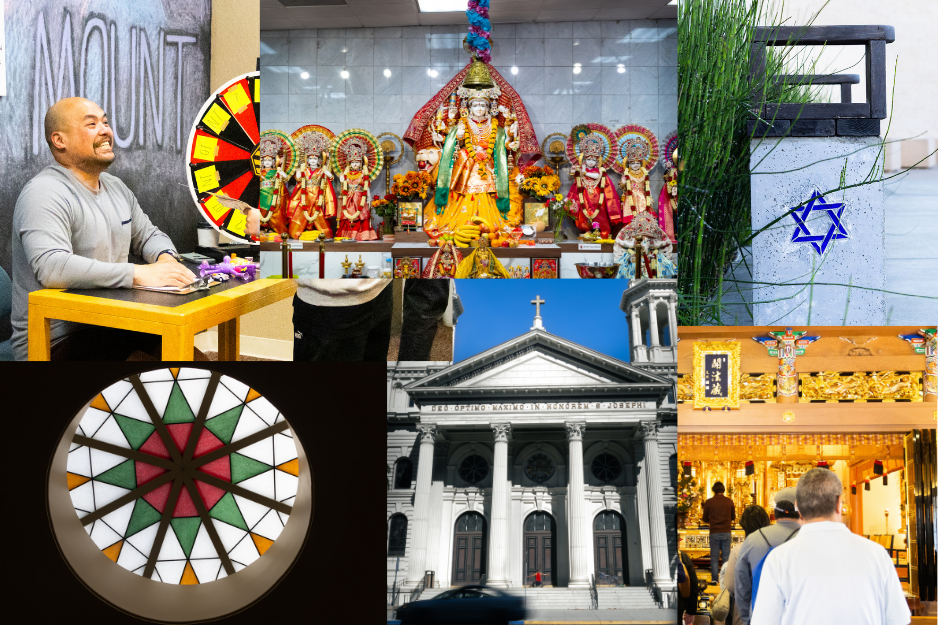



















Faith and politics have always shared a complicated relationship in the United States, a nation founded on both religious freedom and the separation of church and state. Today, that relationship is more visible and contested than ever. From abortion and LGBTQ+ rights to immigrants and foreign policy, religious identity increasingly shapes how Americans vote and which laws get passed.
The founding fathers envisioned a nation with robust religious liberty. They were Christians and deists themselves, but had empathy for almost every background. In his autobiography, Thomas Jefferson expanded that religious freedom to include “the Jew, the Gentile, the Christian and [Muslim], the Hindu and Infidel of every denomination.” The U.S. founders not only wrote religious freedom into law through the First Amendment of the Constitution, but encouraged the participation of diverse cultures and perspectives in society.
“America as a country was founded, at least in part, based on the values of religious freedom,” social studies teacher Luca Signore said. “Religion has always played a big role in political discourse. However, I would say it’s probably diminished from 1900 until today, especially as America has become more diverse.”
Today, religious tolerance can feel like a spectrum, with right-wing politicians emphasizing the preservation of Christian beliefs over assimilation with other religions, while most left-wing politicians push messages entirely unrelated to religion. The MAGA movement is heavily centered around Christian nationalism, an ideology that seeks to merge American identity with conservative Christian identity. Christian nationalists maintain that America was founded as a Christian nation, and that the government should actively promote Christian values.
“There’s been a big movement in this country in recent years toward white Christians as being the norm for the nation,” San José State University political science professor Larry Gerston said. “We’ve seen anti-immigrant issues raised considerably.”
President Donald Trump has fully embraced Christian nationalism. The White House holds worship services, prayer gatherings and discussions of religious liberty. The Trump administration said they created the Religious Liberty Commission to protect religious freedom, but concerns have been raised about the Commission being staffed by Christian nationalist politicians with little representation from other religions. Many conservatives have criticized Muslim presence in America and the election of a Muslim mayor in New York City. Critics say that Trump’s heavy emphasis on Christian values ignores the needs of atheists and members of other religions.
“I don’t think you can necessarily divorce American values from Judeo-Christian values, because a lot of them originate from that,” Signore said. “A lot of Western civilization kind of originates from this Judeo-Christian worldview. So while ideas like equality or helping people in need might not be considered religious ideas today, many of them ultimately have roots in religious thinking.”
Although religious communities have been among the most consistent critics of restrictive immigration policies, religious consensus on immigration is not absolute. Some conservative Evangelicals and Catholics voice that national sovereignty and borders are themselves consistent with Christian teaching, as the state has a God-given responsibility to protect its citizens and that borders don’t stop compassion. Many Christians also assign importance to legal immigration pathways, stating that the bible upholds strict standards for government authority.
“On immigration, at first I thought, ‘Wait, these people are literally just human beings, why are we deporting them?’” junior and Agape Christian Club treasurer Ashley Louie said. “But on further thought, in the Old Testament of the Bible, God heavily emphasizes the borders between each Israelite tribes’ land.”
Abortion is often considered the policy issue that has been most thoroughly shaped by religious influence, particularly the Catholic church. The United States Conference of Catholic Bishops spent decades building legal infrastructure and lobbying state legislatures toward fetal personhood. The politics are more complicated than they appear, though. Following the 2022 Dobbs v. Jackson decision, 59% of Catholics support legal abortions in some form. According to a Pew Research study done in 2020, roughly two-thirds of Catholics said they would not want the Supreme Court to overturn the ruling entirely. This number was similar to overall public opinion, with 70% of Americans not wanting the decision to be overturned.
Since the resurgence of MAGA Republicanism in the 2024 presidential election, many Democrats have started using religion to draw more moderate voters to the left. Texas State Rep. James Talarico recently won the Democratic Senate nomination in Texas. Talarico uses his Christian faith to affirm almost all of his political stances; some describe him like a pastor to his supporters. He has used the Bible to defend abortion and transgender rights. Talarico’s far-left policies — criticizing the existence of billionaires and advocating for universal healthcare — which would normally be unpopular with Texans, are shielded by his Biblical messaging that speaks to voters.
Texas Republicans have successfully campaigned for a “Bible-infused” curriculum for kindergarten through fifth grade curriculums. Lessons include narratives directly from the Bible. This is coupled with a 2025 Louisiana law that mandates all public school classrooms have a poster of the Ten Commandments on the wall. These states along with Arkansas and Oklahoma have been heavily campaigning for more religious influence in schools. Former Oklahoma State Superintendent of Public Instruction Ryan Walters has justified inclusion of these texts into the curriculum by arguing that the Bible is fundamental to understanding American history and the foundation of the Constitution.
“In the early 60s, they made it pretty clear that that religion really doesn’t belong in the schools,” Gerston said. “Clearly, that interpretation of the First Amendment is very different from the interpretation that is running through the courts right now.”
The importance of distinguishing between teaching about religion and teaching from religion has been at the forefront of modern political dialogue. All American students learn about different world religions and their practices, but rarely are students instructed to follow the teaching from any given religious text.
The intersection of religion and U.S. politics reveals our diversity, as well as the constant debate over our constitution. As the United States becomes increasingly polarized, it is more important than ever to understand how religion affects us and the policies that shape our lives.