














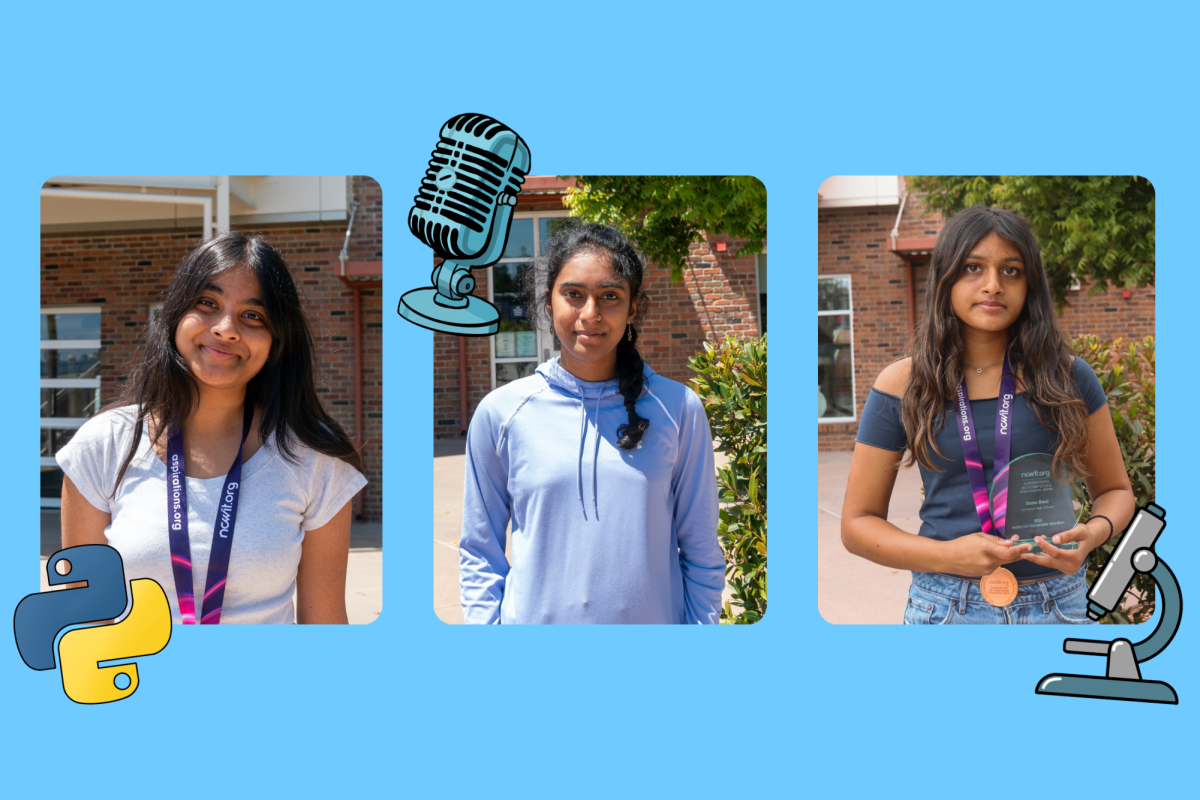
Anshika:
Late at night, the glow of a laptop screen illuminates junior Anshika Gupta’s face as lines of code begin to take shape. What once began as simple Python exercises evolved into projects with real-world impact — earning Gupta the Aspirations in Computing High School Award.
The application was presented by the National Center for Women and Information Technology and required a deep dive into Gupta’s experience in technology and leadership, as well as an essay. She had received an honorable mention last year and advanced to a regional award this cycle.
“I was pretty happy that I improved,” Gupta said. “I definitely want to pursue STEM and tech in the future, so I think this was good motivation for me to continue.”
Gupta’s initial exposure to computing started early; as her older sister pursued computer science. She began taking Python classes in third grade and eventually worked on projects that connected coding to expanding educational opportunities. During a summer program, Gupta worked with a team to develop an app allowing students to anonymously ask questions about topics like health, taxes and growing up.
“That was when I started understanding how coding could connect to building apps or things that actually help people, ” Gupta said.
Now, Gupta is focused on expanding access to computing through her student-led initiative, Tech Quest 4 Youth, which she founded in her sophomore year to introduce younger students to technology. The organization hosts workshops for teens on topics ranging from Python to artificial intelligence.
“There are a lot of different paths you can pursue, so it’s important to try different things and figure out what interests you the most,” Gupta said. “You have to genuinely enjoy something to make a difference.”
Sana:
As the room erupts with clapping and cheers, sophomore Sana Raut feels her heart swelling with pride, knowing her parents are watching as she walks up to her glass AiC award. Years of long nights, sacrifice and dedication have built her up to this moment: making something bigger than herself. The award reflects a passion for research that once started as a middle school summer program and matured into something greater — a research project on colorectal cancer inspired by a history of cancer on her mom’s side of the family.
Raut gathered data samples from hospitals, which took hours of paperwork and forms of intent. Though the process was tedious, Raut was ready to enter the AiC competition two years after starting her project. In addition to her research, Raut gave up free time that could have been spent hanging out with friends to publish a research paper and write countless essays. Despite that, Raut worked hard on her application, while also highlighting her skills in leadership. For her, this meant her roles as a Model UN officer and swim instructor.
“I just wanted to make a project that was exceptional or impactful, but I didn’t really think it would go that far,” Raut said.
While working on her research project, Raut struggled with getting approval from the hospitals for data sets, an obstacle that prevented her from moving further in her research. Luckily, her mentor, a professor and Stanford alumnus, helped her through her struggles by giving her advice and leading her in the right direction. Still growing and learning the best way to approach challenges, Raut looks forward to when she will finish her newest project, focused on improving accessibility and quality of drug treatments for leukemia.
“Winning this award has motivated me to keep on pursuing research,” Raut said. “I can see how it actually makes an impact on other people, and how other people who are interested in research can read these papers and maybe find something more groundbreaking based on them.”
Shripriya:
For junior Shripriya Kalbhavi, biology has always been captivating. Meanwhile, an elementary school club for Scratch programming sparked an early interest in computing. With these two new passions, Kalbhavi realized that she could merge her interests as she entered high school. This was her entrance to a whole new world of fascinating research. Her love for STEM eventually led her to apply for the AiC award. Although she hadn’t expected it at first, the award was a much-appreciated outcome. To her, the AiC award was more than just a medal, but a doorway of opportunity for girls who dream of pursuing a career in technology.
“When I heard I got the National award, I was super excited, and a little shocked.” Kalbhavi said. “They only pick 40 people.”
Kalbhavi’s projects often begin with a crazy idea that she shapes to become more realistic, going through a long process of code-shaping and tweaking. The award was incredibly special to Kalbhavi, especially since her AiC award project focused on ALS, a neurodegenerative disease, which Kalbhavi hopes to use computational biology to help better study. The biggest challenges she faced often came down to data limitations and computing power: home computers sometimes struggled to keep up with her code.
One of her favorite projects is her podcast: The Double X Effect. It explores strong women in STEM who have trailblazed the path for others and provided new perspectives on the modern world.
“Just put yourself out there,” Kalbhavi said. “Make connections that will help you in the future. Your best asset can be some of the people around you.”