


















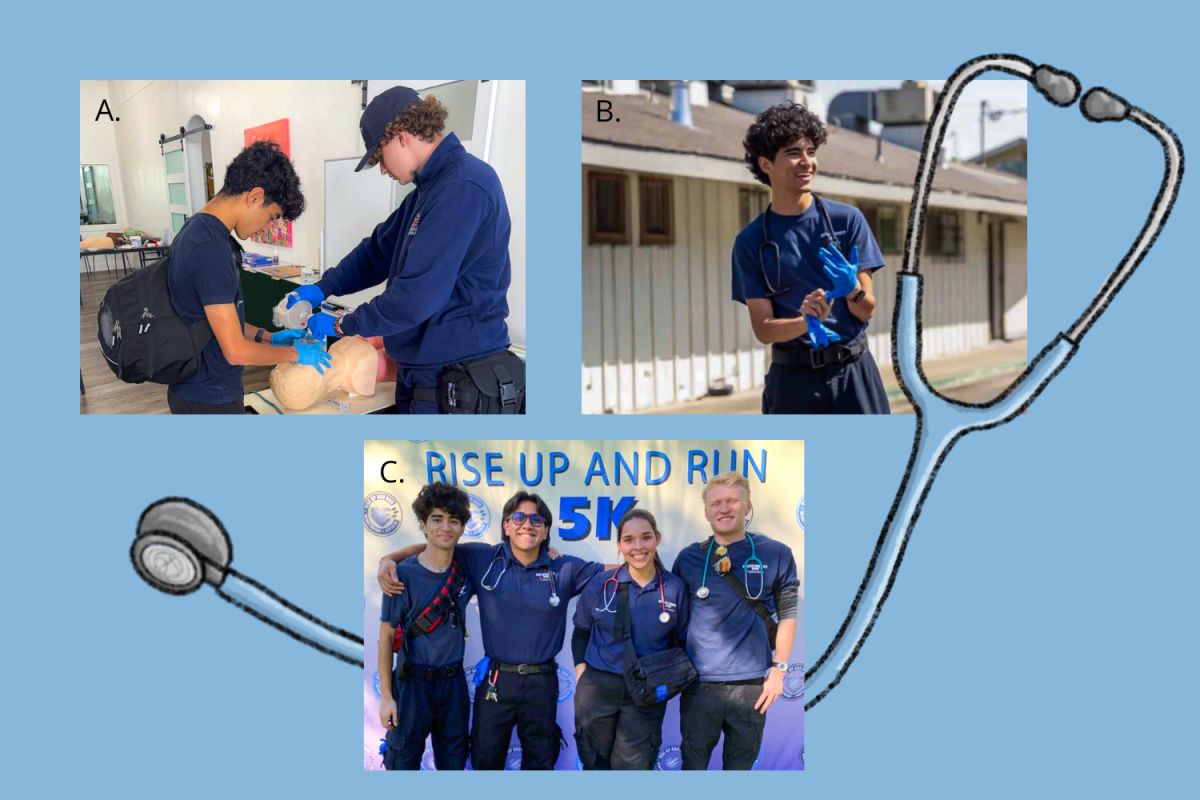
As sirens cut through the night, senior Ilan Garcia steadies himself in the back of an ambulance, eyes on the patient before him. He positions the stretcher and prepares for the emergency response. Whether he is helping crews manage patients or supporting Lynbrook athletes as an athletic training intern, Garcia assists people during moments of medical uncertainty.
Garcia’s interest in emergency care began the summer after his freshman year. Biking home from a friend’s house, a truck struck him as he crossed the intersection. He suffered deep cuts, abrasions and two sprained ankles.
“When the accident happened, everything felt chaotic and I was really scared, but the medics and firefighters weren’t,” Garcia said. “That was the first time I understood what it meant to be a real first responder and how helpful they were in calming me down.”
At the end of his sophomore year, Garcia began shadowing athletic trainer Scott Leveau, who later worked with him to build the Athletic Training internship. Under Leveau’s guidance, he learned to support injured athletes, from taping ankles to managing rehabilitation plans.
“Ilan treats every medical situation with the same level of professionalism that you’d expect to see in someone who’s been in their role for years,” Leveau said. “I’ve learned so much from him and I’ve become a better Athletic Trainer because of it. He is the epitome of what a medical professional should be.”
By the end of junior year, Garcia wanted to pursue formal first responder training at South County EMS Training Center in his senior year. Four days a week after school, Garcia commuted to Gilroy for lectures, scenario practice and lab sessions. Students practiced patient assessments while instructors created realistic simulations of 911 calls.
“It felt like a college class, but with real pressure behind it,” Garcia said. “You’d study something one night, and the next day you were practicing it in labs.”
Garcia’s practical training took him to several emergency care agencies. At Royal Ambulance in San José, he gained direct experience in a non-emergency setting. Training officers critiqued his work, which included checking equipment before shifts and performing patient assessments. At the busiest point in his schedule, he worked up to three 12-hour shifts a week.
Eventually, Garcia moved on to assist real 911-level emergency response through the San José Fire Station and Santa Clara County Ambulance. These situations involved extreme patient conditions like heart attacks and car accidents. Shadowing paramedics, Garcia prepared equipment, took blood pressure and relayed clinical information.
Garcia hopes to study medicine in college, eventually pursuing a career in emergency care or sports medicine.
“I don’t know exactly where medicine will take me, whether that be medical school or a professional career as an EMT,” Garcia said. “I do know that helping people is where I’m meant to be.”