



















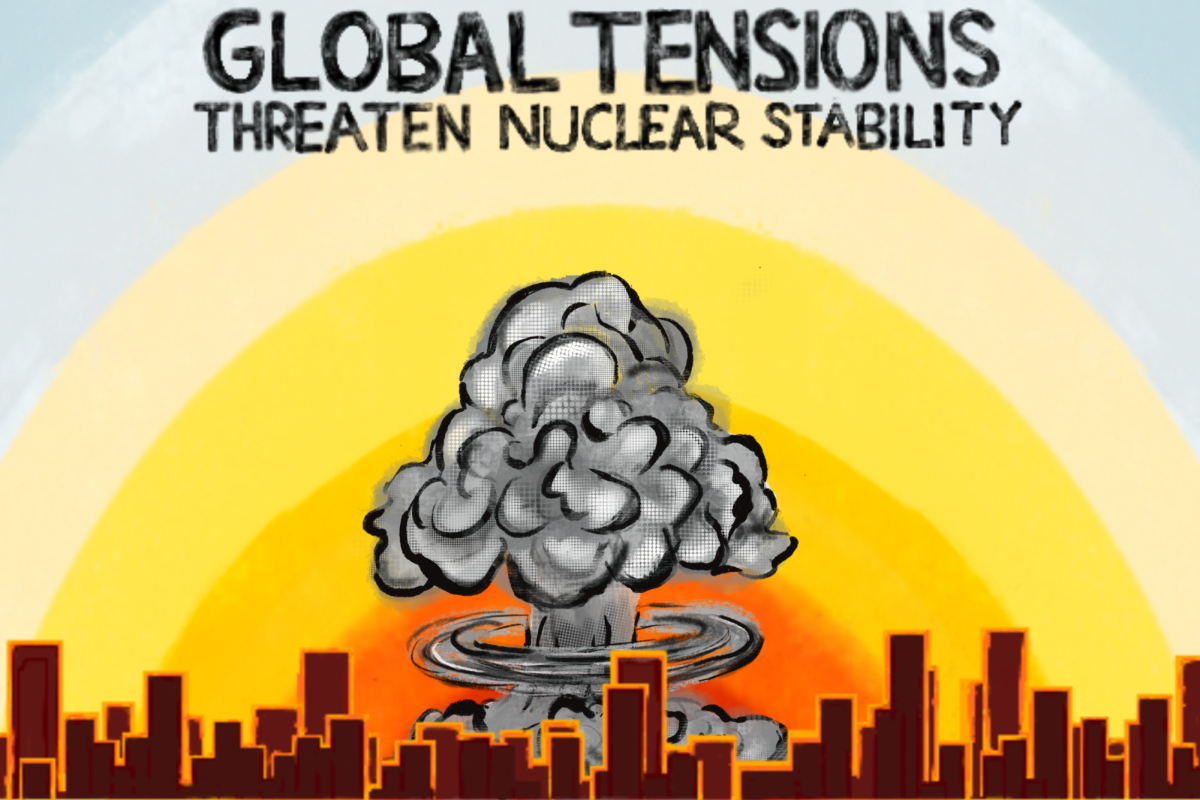
- Donald Trump reopens possibilities for nuclear testing with recent Twitter statements.
- Donald Trump claims Russia and China have conducted secret nuclear tests, these statements were denied by the respective countries.
- Since the signing of the Comprehensive Nuclear Test Ban Treaty, the United States has sworn off testing alongside 186 other countries.
- Non-critical nuclear testing may be resumed to be a deterrence against opposing countries.
In a tweet on Oct. 29, President Donald Trump commanded the Department of War to start testing nuclear weapons, effective immediately, renewing uncertainty around the future of nuclear testing. During an interview in October, he claimed that China and Russia were conducting secret nuclear tests and suggested that the United States shouldn’t be “the only country that doesn’t test.” Such assertions, if accurate, could indicate potential violations of the 1996 Comprehensive Nuclear-Test-Ban Treaty, although both Russia and China have denied conducting prohibited tests.
Though only a recent invention, nuclear technology has the potential to turn threats of war into promises of destruction. When the Manhattan Project was unveiled in the Smyth Report just days after the bombings of Hiroshima and Nagasaki in Japan, all notions of international diplomacy were altered. World powers raced to catch up, and by 1964, both Russia and China had developed nuclear weapons.
By testing increasingly powerful devices, these nations built substantial atomic stockpiles. In the U.S., programs invoked federal laws of eminent domain to test the technology on remote sites. However, in doing so, the government displaced Native American tribes and entire communities, often with limited compensation.
One of these sites, Los Alamos, became the location for the first nuclear test in history. Its explosion from the 1945 Trinity test was visible from over 200 miles away. Radioactive fallout reached nearby communities, including Native American populations and project workers, causing radioactive illnesses that lingered for generations. An estimated 600,000 people were exposed to dangerous levels of radiation, many of whom later developed serious health issues like cancer. Nuclear tests also contaminated soil, air and water with radiation, damaging ecosystems.
“We cannot ignore the environmental impact in these areas and places where the weapons are being tested, whether it’s above or below the surface,” De Anza College professor of U.S. history Lindsay Bell said.
After discovering the consequences of open-air testing on human health, the U.S., the Soviet Union and Great Britain signed the Limited Test Ban Treaty in 1963, banning nuclear detonations in the atmosphere, underwater and in outer space. Since the treaty did not explicitly restrict underground testing, the U.S. conducted 760 nuclear tests in large underground tunnels between 1962 and 1992. However, underground testing did not prevent toxic radioactive materials from polluting soil and groundwater.
Such testing raised tensions between the U.S. and the Soviet Union as both nations competed to build a larger stockpile of nuclear weapons. Amid continued concerns about environmental and health effects, the two countries signed the Threshold Test Ban Treaty in 1974, limiting underground tests to atomic bombs that had an energy yield of 150 kilotons — roughly 10 times the size of the Hiroshima bomb.
With such limitations presented, both countries implemented a moratorium on underground nuclear testing in 1992. This temporary suspension laid the foundation for the Comprehensive Nuclear Test Ban Treaty, which prohibits all nuclear explosions, regardless of location or yield. While the U.S. signed the treaty along with 186 other countries, it has not been formally ratified, leaving open the possibility of resuming tests.
In recent times, analysts have noted that several nuclear-armed states appear to be expanding or modernizing their arsenals. Since 1998, only North Korea has conducted an announced nuclear test. Russia and China are allegedly developing new delivery systems, while the United Kingdom and France have reportedly undertaken modernization programs of their own. The current atmosphere is an ominous sign for future nuclear testing that could be more dangerous, creating fear within U.S. defense and policy circles.
“I think if you see one great power moving backwards on what is essentially an arms limitation treaty, other countries go, ‘Well, they’re doing it, so we can do it too,’” social studies teacher Steven Roy said. “It’s not deterrence. It’s allowance.”
After global powers paused testing, the threat of nuclear destruction seemed neutralized for good. Yet after 33 years without U.S. tests, Trump’s tweet unleashed the possibility of another age of nuclear testing after decades of restraint, sparking Democrat concerns.
“There are many people who are afraid of the risks that are brought by nuclear warfare,” senior John Jou said. “It would increase political polarization, because it is a controversial issue and there are people who care a lot about it.”
If the U.S. restarts testing, other nuclear-armed states might respond by resuming or accelerating their own programs. As Trump has not offered clarification for his statement, it is unclear whether his comments refer to large-scale tests like those of 1945, or smaller experiments, such as computer simulations or forensic monitoring to check the condition of current nuclear weapons.
Supporters have cited several motivations to restart nuclear testing. One major rationale is maintaining a credible nuclear deterrent against other nations. By continuously adding to its weapons arsenal, the U.S. aims to reassure allies of its attention to security. In addition, advances in technology may allow some testing to occur without massive detonations, potentially limiting environmental and safety risks.
“The conclusion is that at some point, we’ve learned all we need to know about atmospheric and subterranean testing,” Roy said. “It is hard to envision the basic nuclear weapon design getting that much better.”
With ambiguous signals from government officials, whether the U.S. will enter a new era of nuclear testing or if major powers will maintain the current stalemate remains to be seen. However, it is evident that the possibility of resuming nuclear testing has the potential to reshape the world’s political landscape yet again.
“Nuclear weapons were believed to be a deterrent because of the prospect of nuclear armageddon,” Bell said. “But as we see in the world today, wars continue, and the more that nuclear weapons are present, the greater the international security risks for the entire world that one nation alone is unable to resolve.”