

















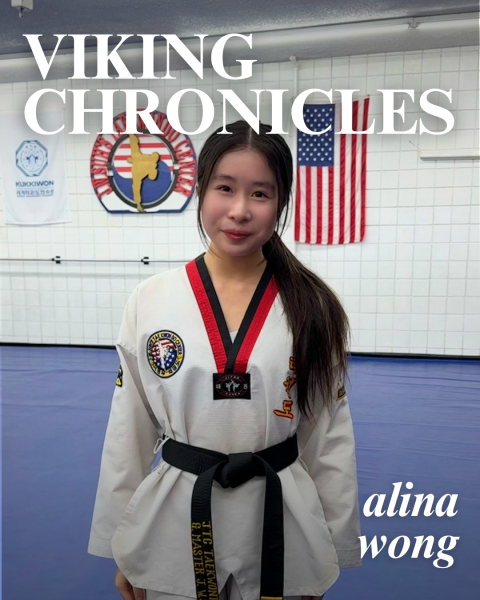
Stepping onto the blue mats, sophomore Alina Wong feels peace wash over her. In taekwondo, she has found a supportive community and a place for growth, both within herself and among the students she teaches.
Wong began her journey right before the COVID-19 lockdown, choosing the sport for its fluidity. On the waitlist for the next level of gymnastics, she chose to switch to taekwondo with her father’s encouragement.
“As a girl, self-defense is important,” Wong said. “I watched some taekwondo videos on YouTube, and I thought it was really cool, so I decided to give it a try.”
At 9 years old, she stepped into JTC Taekwondo Studio for the first time. In a primarily male-dominated space, Wong felt anxious and missed the predominantly female community of gymnastics. After just a few months in the dojang, COVID-19 forced classes to move online, making learning more challenging.
“I was so scared at first, and I really did not like it,” Wong said. “Online learning was really, really difficult for me because I had limited space, couldn’t get hands-on corrections and honestly wasn’t sure if I did half the stuff correctly. But over time, taekwondo kind of grew on me.”
In May 2022, Wong returned to the studio in person. Although she had to adjust to masking up, she improved faster with immediate instructor feedback and peer practice. Two years later, Wong tested for her first-degree black belt. Intense training — including running 7.5 miles and creating a unique kick combination to break boards — made the test a monumental achievement for her.
“After first degree, I told myself, ‘I’m not testing again,” Wong said. “It was so much stress for me leading up to that moment. Obviously, after actually doing the test, it was a really, really cool moment for me, like, ‘Wow, I can’t believe I just did that.’ If you told 9-year-old me that someday I would get a black belt, I wouldn’t have believed you.”
After the accomplishment, Wong gradually stopped going to taekwondo classes. As a figure skater and member of the cheer team, she was forced to prioritize. She went from practicing twice a week to around once a month. But after the 2024 cheer season ended, she decided to return to the dojang.
“I came back randomly, not in uniform, just to talk with my master,” Wong said. “She was super happy to see me, and actually offered me the chance to volunteer as a coach. Part of the reason why I came back was because I could coach, so I obviously agreed.”
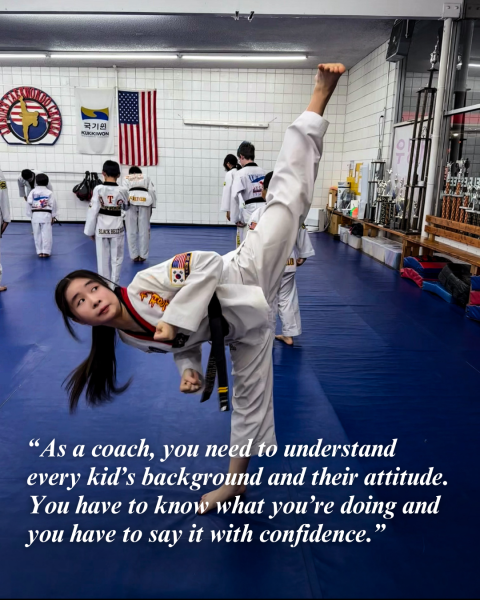
Wong had to relearn nearly everything, starting from basic white belt movements. Meanwhile, she also shadowed another coach to learn their teaching style. This summer, she fully committed to taekwondo, regularly attending and leading classes. Now, instead of shadowing others, she herself is training a future coach.
“I’m not doing it for college apps and all of that,” Wong said. “I actually think that it improved me as a person, in understanding people better, really seeing what they struggle with and what I can do to help them.”
As an instructor, Wong has learned to adapt her teaching style for various ages, from toddlers to adults. She vividly recollects helping a student struggling with anger issues. However, with patience and time, he began to let his guard down and trust her. Although her students’ high energy often causes chaos, it also brightens her day.
“As a leader, you need to understand every kid’s background and their attitude,” Wong said. “You have to know what you’re doing and you have to say it with confidence. Coaching has taught me courage, in a way, and that it’s okay to just speak out.”
Wong has learned that by explaining moves and techniques to others, she can improve her own skills. Testing for her second degree in September wasn’t stressful because she had gotten to personally know the masters evaluating her.
“A future goal for me is definitely to go to a competition, and possibly get my third degree, but I’m not too sure about that one,” Wong said. “But I definitely want to learn more cool kicks.”