



















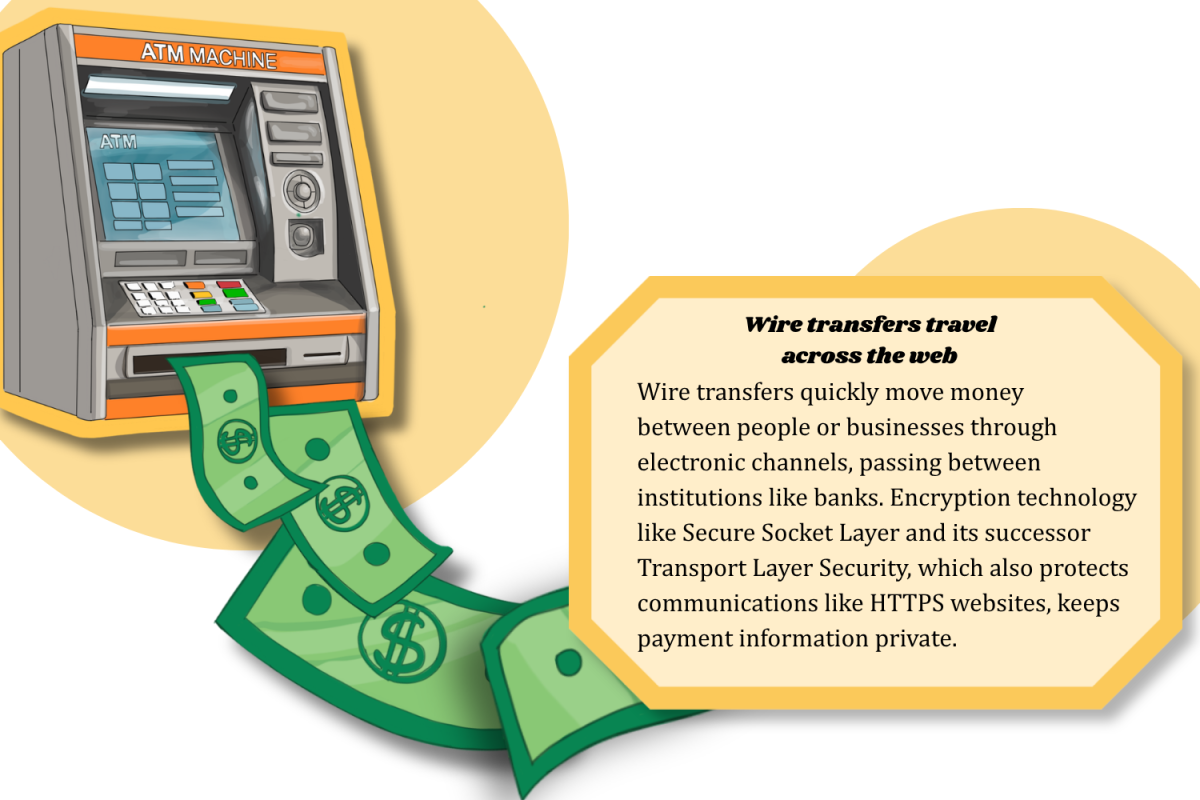
- With modern technology improving rapidly, the way humans exchange money has evolved from physical bills to cashless transactions.
- While issues of privacy and accessibility remain, cashless formats like credit cards and mobile payment apps are increasingly common.
- Recent years have heralded new advancements, such as AI-powered detectors and biometric authentication.
In checkout lines at a Stockholm store, neither the jingle of coins nor the rustling of paper bills fills the air. Instead, customers hear an electronic beep, confirming an entirely cashless transaction.
In 2024, 85% of global transactions were reportedly cashless. Countries like Sweden have even begun to refuse it entirely: many shops no longer accept physical money, instead opting for mobile payment apps like Swish. At Lynbrook, contactless payments began to gain popularity in 2022, when the administration approved new software.
“We have tap-to-pay in the office,” ASB financial specialist Supriya Lawrence said. “We have GoFan, a type of payment software. We also have Square and our student store. There’s quite a few options available for students, so by this school year, almost 68.6% will come from cashless transactions.”
At its core, a cashless transaction is a ledger system, symbolically recording a reduction on one side and an addition to the other. Ledgers date back to ancient Mesopotamia, while modern double-entry bookkeeping emerged in Renaissance-era Italy.
“The idea of cashless payments, in a sense, is actually really old technology,” said Chenzi Xu, assistant professor of economics at the University of California, Berkeley. “It’s just that our communication has become sufficiently better and integrated so that you can use them for daily transactions instead of just the really big ones.”
However, it was only in the 20th century that integrated visions of a cashless world emerged. Researchers and consultants proposed a “checkless society” in which digital networks replace paper checks. In the 1950s, United States banks began issuing credit cards en masse, following in the footsteps of department stores, gas stations and other merchants that had been issuing them since 1914.
“It’s remarkable how I never have to take cash out of foreign ATMs,” said Kris James Mitchener, professor of economics at Santa Clara University. “Credit cards were kind of the intermediary step. They’re still ultimately tied to a bank account somewhere, but the physical manifestation of currency trading hands is on its way out.”
The same time period also saw the advent of cash-dispensing networks. In Sweden, coin-sorting machines for trustee savings banks were developed in 1960 to distribute cash outside open hours and streamline the work of human tellers.
At the turn of the 21st century, the field of public key cryptography, which uses data strings called keys to encrypt information, gave rise to a new form of payment: cryptocurrencies. Despite market crashes and regulatory scrutiny, their daily global market caps now climb into the trillions.
“Many cashless societies tend to be countries that don’t rely very much on their local currency,” Xu said. “In many Latin American countries — Argentina, for instance — people transact in Bitcoin or in other forms of crypto because their local currency is so unstable.”
The COVID-19 pandemic caused another global surge in contactless transactions. Amid widespread quarantines, physical cash became not only unusable but even risky due to its potential to spread disease. In the U.S. alone, the use of cashless payments increased by 150% from 2019 to 2020, according to iMin.
Supporters embrace the ease and efficiency of cashless transactions, which also leave a trail for consumers, businesses and governments to track spending, revenue and even financial theft. Unlike with cash, consumers are often protected if their credit or debit cards are lost or stolen.
“When I need to pay for something, I just bring my phone because I tap to pay,” sophomore Jiuxi Chu said. “It’s a lot more convenient. If I had to pay someone back, I would use cash. But if I’m paying for myself, I always use tap-to-pay.”
While digital transactions are often convenient, they can also come with notable complications. Older generations may find the domination of cashlessness confusing and unfamiliar: 71% of U.S. adults over the age of 50 try to always have cash on hand, compared to 45% of adults under 50, according to a 2022 Pew Research Center poll.
A cashless civilization also raises issues of privacy and availability. Cashless accounts can tempt hackers, who may disrupt the network, take money and steal personal information. Poor internet connections or IT failures risk blocking access in underserved areas. Relying on contactless payments also means users spend extra money, as some businesses charge for tap-to-pay transactions.
“Credit card transactions will involve a fee,” Lawrence said. “We have to pay those fees to the issuing banks and payment processors; that’s what makes it secure. Since it’s a fixed component, when it’s a very small transaction, the fee becomes disproportionately large.”
Growing digital dependency is creating new ways to process transactions. Artificial intelligence had a 70% success rate of detecting false transactions in 2025. Now, biometric authentication offers comfort to users who worry about reliability, compared to keeping loose bills lying around. Money’s future is fluid and undeniably unique around the world, but technology will likely continue to shape how transactions occur.
“The younger generation is just used to using digital payment,” Michener said. “The ease with which it allows you to buy and sell whatever you want just strictly dominates cash. I could see almost all transactions being cashless in the near future, though for equity reasons, we still may have some cash circulating.”