




















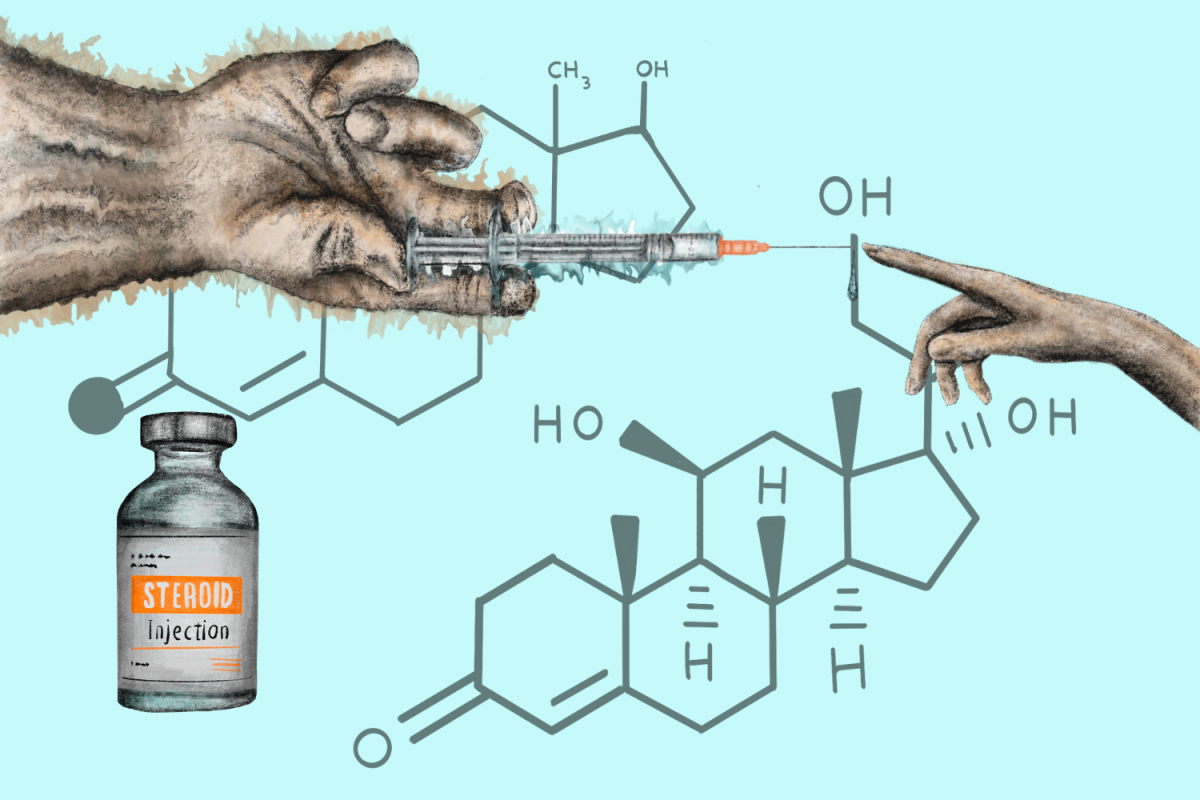
Performance-enhancing drugs aren’t restricted to professional athletes. From synthetic human growth hormones and blood doping to seemingly unassuming sports gels and supplements, the drive to perform better — or the desire to look the part — is intense among teen athletes. In the Bay Area, where competition defines sports as well as academics, that pressure can push young athletes toward risky behaviors.
PEDs are defined as substances taken to improve athletic or physical performance beyond normal training and nutrition, according to the U.S. Food and Drug Administration. Recent data suggest that the use of PEDs is not limited to a small subset of athletes. One type of PED in widespread use is anabolic-androgenic steroids, synthetic drugs designed to imitate testosterone, the primary male sex hormone. A 2022 analysis of United States Risk Behavior Survey data reports that about 3% of U.S. high school students have used anabolic-androgenic steroids at least once in their lifetime, a percentage similar to that of students who have tried drugs like cocaine, methamphetamine or heroin. In another survey released by the Partnership for Drug-Free Kids in 2025, one in five teens reported that they knew at least one friend who used steroids.
The growing popularity of PEDs can be traced to a mix of cultural and environmental pressures, particularly in competitive regions like the Bay Area. As expectations for both academic and athletic success continue to rise, many students feel pushed to seek any possible advantage. Sometimes, this means turning to steroids.
“On school teams, there’s this unspoken pressure to perform,” senior and Athletic Senate member Chloe Chung said. “When everyone around you is pushing their limits and competing for the same spots, it can feel like you have to do whatever it takes just to keep up, even if that means taking things or doing things you normally wouldn’t.”
At the same time, it is increasingly difficult to distinguish between clearly illegal drugs and widely accepted supplements that are growing in cultural popularity. This blurred line is evident in the widespread use of legal supplements such as protein powders, pre-workout formulas, creatine and sports drinks. An analysis of FDA warnings from 2007-2016 found that 776 dietary supplements, primarily for weight loss or muscle building, contained unapproved pharmaceutical ingredients, commonly synthetic steroids or steroid-like substances.
“A lot of swimmers don’t think of supplements as risky at all,” senior, varsity swimmer and swim team manager Yuka Miyamoto said. “It usually starts with things like protein or pre-workout formulas, and because that feels normal, it doesn’t seem like a big jump when people start considering stronger options.”
Performance-enhancing substances can also come in the form of trends. One example is PRIME energy drinks, promoted aggressively online by influencers Logan Paul and KSI. Quickly growing over 1.2 billion dollars in global sales within its first year of release, PRIME became extremely popular among middle and high school students. However, these drinks contain caffeine levels high enough to trigger calls for an FDA investigation and school bans. Similarly, protein powders and gels for runners have gained traction. Some contain synthetic stimulants or hormone analogs, which can raise heart rate, raise blood pressure and interfere with normal growth in adolescents.
High-profile cases and local history further illustrate the extensive scope of this issue. In the Bay Area, the BALCO scandal remains one of the most well-known examples of doping, where a seemingly legitimate sports nutrition company was exposed as a manufacturer of anabolic steroids and other PEDs for professional athletes. These examples reinforce a larger pattern: performance-enhancing substances are often introduced as tools for improvement, but carry unforeseen consequences.
While often associated with athletic performance, PEDs are also widely used to enhance physical appearance, particularly in environments where idealized body standards are constantly reinforced. On the internet, students are not only comparing themselves to their peers and teammates. They are also being constantly bombarded with idealized, algorithm-approved bodies on TikTok, Instagram and YouTube. Additionally, many actors use PEDs to tailor their appearance for a role that they are playing, with famous figures such as Superman actor Frank Grillo coming forward to reveal the widespread steroid use in Hollywood.
“It’s an evolving problem,” sports psychiatrist Francesco Dandekar said. “If you look at Batman in 1970 or 1980, you’ve got a normal dude. Same with James Bond. Now, Batman and James Bond are just shredded. A lot of these actors are using PEDs to achieve that, and there are all these graphic representations of what athletic people are supposed to look like.”
High school is a time of intense pressure for most student athletes, leading to the rise and abuse of PEDs among youth. Though sometimes through clearly illicit substances, this growth is just as harmful when hidden behind trendy drinks and supplements.