













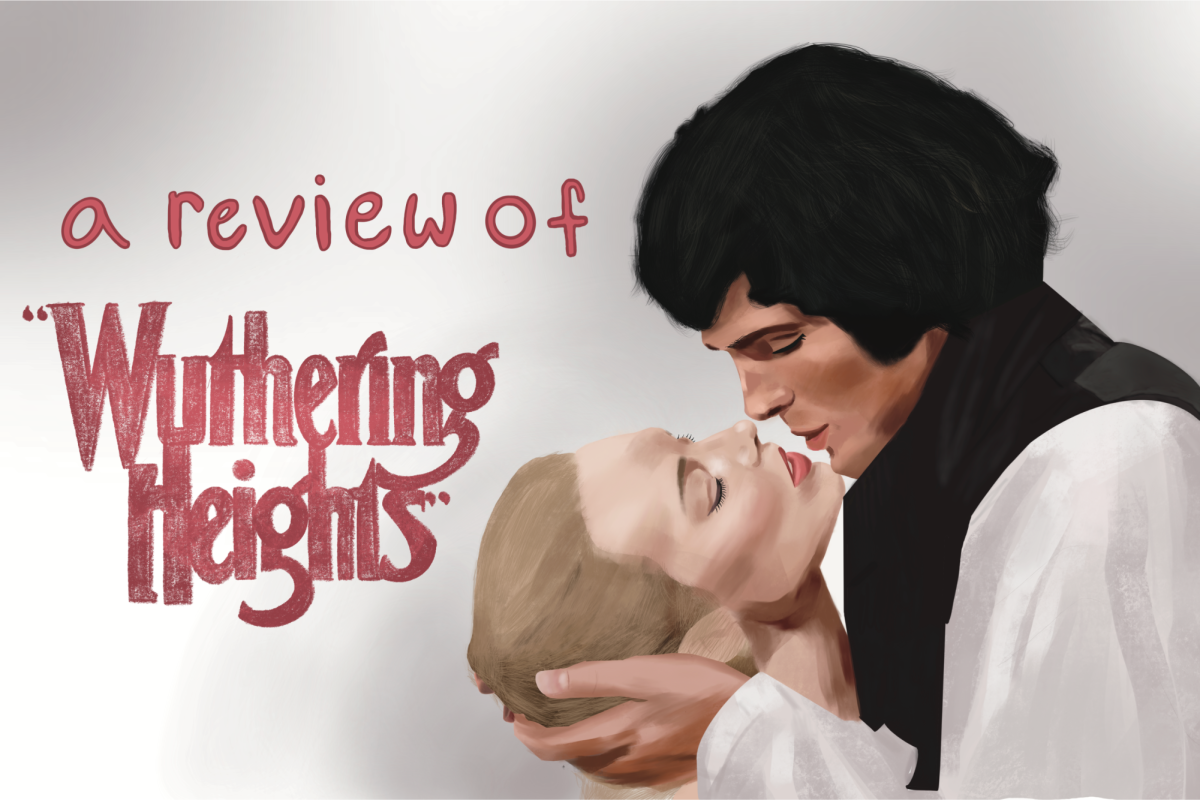
Director Emerald Fennell’s “Wuthering Heights” begins with the dying gasps of a hanged man. As the screen lingers in darkness, the sound remains uncomfortably ambiguous, hovering somewhere between pain and pleasure. Such an opening seems to promise an intriguingly morbid exploration of the doom, gloom and Gothic passion of Emily Brontë’s masterwork. Yet as the movie soon reveals, this couldn’t be further from the case — despite all its arresting bells and whistles, the “Wuthering Heights” film is a shallow, misconstrued adaptation that erases everything that made the 1847 novel a classic.
There are some highlights: for example, its unique environment shines because it commits fully to historical inaccuracy. The visuals opt for sumptuous beauty and emotional storytelling. Catherine Earnshaw, played by Margot Robbie, dons a new, eye-catching outfit in every scene; during her wedding to Edgar Linton, her white veil billows majestically in the wind. She wears the same veil to her father’s funeral, this time in black — a contrast that raises appropriately Gothic parallels between love and death. Similarly, sets like Thrushcross Grange, home to the wealthy Linton family, bloom with wacky, “Alice in Wonderland”-esque intrigue: Catherine’s, or Cathy’s, bedroom walls are patterned like her flesh, and the fireplace looks like a swarm of reaching hands. Through it all, panoramic shots and liberal use of fog bring the iconic moors to breathtaking life.
The film also excels in the auditory department, which often conveys the novel’s signature atmosphere better than the movie’s plot itself. While composer Anthony Willis’ classical score is fittingly melodramatic for the emotions at play, an accompanying album by Charli xcx leans further into the anachronism. Brontë certainly didn’t listen to pop songs with orchestras and Auto-Tune in her lifetime. Yet in capturing a rawness that borders on grotesque, Charli’s music is just as unflinchingly turbulent as Brontë’s own creation; neither the piercing wails in “House” nor the lyrics “put my flesh upon the cross until I scream” in “Eyes of the World” would be out of place in a horror movie.
However, the depth of atmosphere only highlights the pitfalls of Fennell’s new narrative rather than salvaging it. One of the most glaring issues is its erasure of the intersectionality of race, class and gender. In the novel, Heathcliff’s racial ambiguity — he is described as a “dark-skinned gypsy,” or perhaps an “American or Spanish castaway” — is central to his social ostracization, which informs his development and complex motivations. Conversely, Cathy experiences the privileges of whiteness but also the obstacles of femaleness, even as her passion makes her anything but a stereotypical damsel in distress. These societal contrasts are intrinsic to their dynamic, and the novel is more than willing to grapple with their uncomfortable implications. Yet Heathcliff is played by Jacob Elordi, a white actor, causing such tensions to disappear and flattening some of the most compelling aspects of his relationship with Cathy.
Indeed, the movie erases almost every nuance of the original. For example, an omniscient third-person point of view replaces Brontë’s story-within-a-story format — which called the biases of each narrator into question — and removes the intrigue of uncovering the complicated truth. Additionally, it paints Cathy and Heathcliff as little more than a doomed love story. The harsh edges are sanded here: sexual desire replaces the specter of violence, and contrived tragedy substitutes their intrinsic destruction. By ending on Cathy’s death, the movie entirely sidesteps the book’s intense, supernatural second half, which sees Cathy’s ghost return to haunt Healthcliff and explores heavy themes of abuse and intergenerational trauma.
To be fair, Fennell has emphasized that she wasn’t aiming for one-to-one replication, but rather “making a version” of the original that “isn’t quite real.” Yet even on its own, the storyline falls flat. The second half especially drags when Heathcliff returns to his childhood home of Wuthering Heights: his affair with Cathy is a broken record of identical sexual encounters, which attempt to titillate yet quickly grow repetitive. These meetings largely fail to develop Cathy and Heathcliff’s dynamic — a shortcoming compounded by the lack of chemistry or any real personality beyond their relationship. Repeated utterances of “I love you” aren’t enough to sell ostensible attraction.
While the “Wuthering Heights” movie’s commitment to fully depart from the novel seems intriguing at first, it derails into a one-dimensional story that neither honors the original nor holds its own as an independent creation.
Rating: 2 Viking helmets out of 5