


















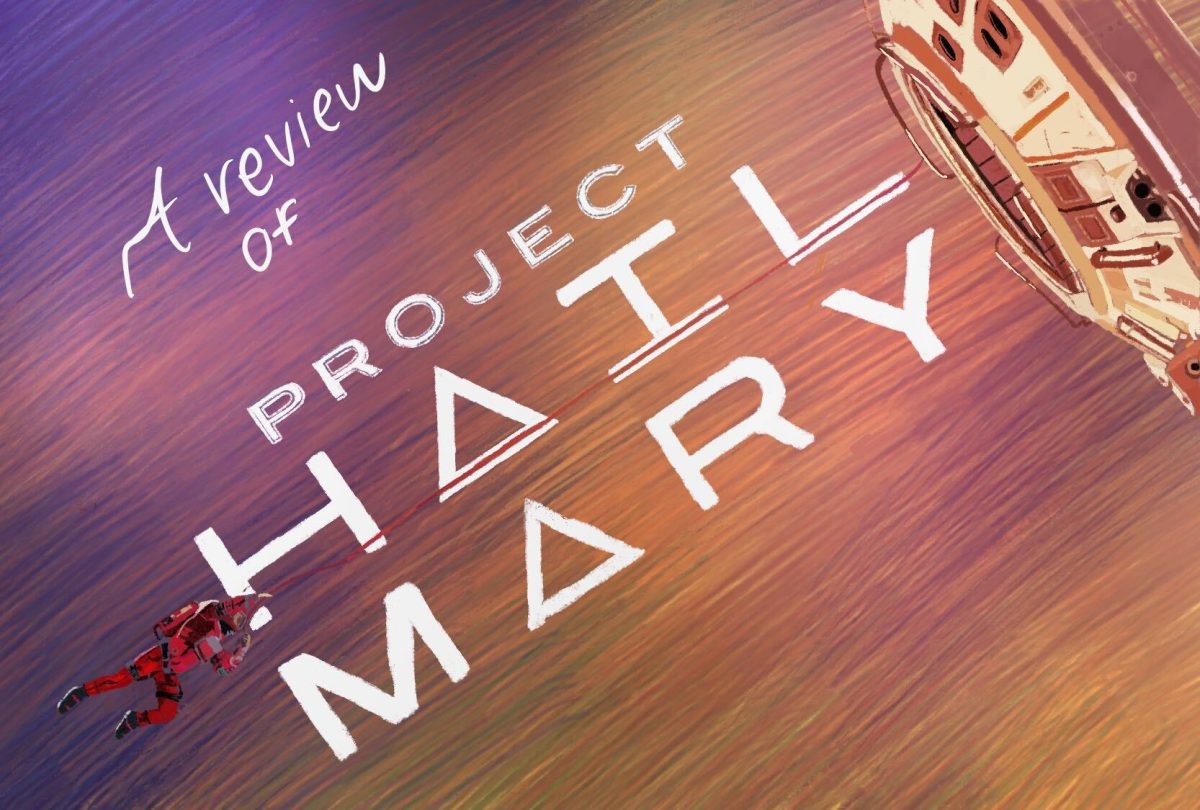
Directed by Phil Lord and Chris Miller, “Project Hail Mary” follows middle school science teacher Ryland Grace, a man with ambitions anchored firmly on Earth but knowledge soaring beyond the galaxy. In this adaptation of the 2021 Andy Weir novel of the same title, Grace, played by Ryan Gosling, is tasked with saving the sun from the light-consuming microbes known as Astrophages. However, Grace’s greatest obstacle is his dubious bravery, a recurring theme throughout the film. “Project Hail Mary” solidifies itself as a film that meets, and arguably surpasses, the hype of its source material. The film portrays grand salvation and courage, embedding Weir’s realistic storytelling with breathtaking performances to create a modern masterpiece.
The film opens in a similar way to the novel, with Grace unconscious on a spaceship, dazed and confused. When he wakes up, he is unable to remember anything before he arrived, nor can he speak in cohesive sentences. In the novel, Grace expresses his confusion through barrels of internal dialogue. In the film, however, a cluttered environment surrounds him: machines disturb the silence, representing Grace’s turmoil. The use of silence and the spaceship’s visual disorganization is a very interesting touch by the directors to portray Grace’s confusion, rather than bombarding viewers with long, reflective monologues early on — a technique that works well in literature but makes a difficult transition to film.
The film also shines in its individual performances. Gosling’s range is nothing new to many viewers, as shown by the 2004 romantic drama “The Notebook” and 2016’s lively and humorous “The Nice Guys.” When it comes to this film, however, Gosling gives a performance that blends the best of all his acting worlds. Whether it be through his short quips to his students in the classroom or his heartfelt interactions with Rocky — Grace’s rock-figure alien assistant and friend — Gosling evokes tears of both happiness and sadness throughout the film, making me view him as an obvious yet early Oscar nominee prediction this year.
Going into the film, I had minimal knowledge about Sandra Hüller, who plays Eva Stratt, the woman in charge of the Project Hail Mary mission. In fact, my first time seeing her was in the trailer for the movie. That being said, this is my formal apology to Hüller for not being aware of such a talented actress with an incredible emotional range. Stratt’s entrance in the film, just like in the novel, depicts her as a stone-cold leader seeking only success, disregarding the emotions of those around her. However, we learn to empathize with the character and understand why she does what she does. During a scene where all the project members are in a bar, Stratt begins singing “Sign of the Times” by Harry Styles. For the first time in the film, she bares her true feelings. From these raw emotional moments, I was finally able to recognize Stratt’s understanding of each project member’s mental fortitude. Her depth and character growth from a resolute leader to a compassionate survivor make her a standout aspect of the film.
In films, directors often use variations in lighting to portray a larger message or theme within a moment. Lord and Miller execute this idea almost perfectly during Grace’s time in space. We see this in two moments: when the Petrova line is first introduced, and when Grace’s spaceship is falling apart. The Petrova line — the light trail created by the sun-killing Astrophages — is first shown as a reflection on Grace’s face, rather than the actual trail outside the spaceship window. Initially, it falls right below his eyes, telling audiences that Grace is not yet able to truly understand it. Right after this, the light from the line moves upwards to Grace’s eyes, nearly blinding him. He has now realized what the Petrova line is, leading him to discover that it is made of life rather than infrared rays.
Another clever use of lighting appears late in the film when Grace and Rocky attempt, but fail, to save their spaceship. We first see the spaceship spiraling out of control, providing context for the characters’ state of disarray, a metaphor for their isolation from everyone. Afterward, the lights inside the spaceship begin flickering, serving as a cut between scenes of struggle and communication. This makes the audience feel as if we are there with them, struggling to pull ourselves together. Although these are subtle details in brief scenes, they helped me understand the film’s message of human understanding and provide much-needed context for the beginning of Grace’s tumultuous path to salvation.
By deviating from its source material at times, “Project Hail Mary” distills and improves the original novel, exploring the relationships between humans and their bravery in helping others. The film explains every fictional scientific discovery in great depth, almost as if the audience were attending a university lecture on astrophysics, with every character as a professor. It excels in not only drama and action but also reflection and emotion. I left the theater with only three words to describe it: “amaze, amaze, amaze.”