

















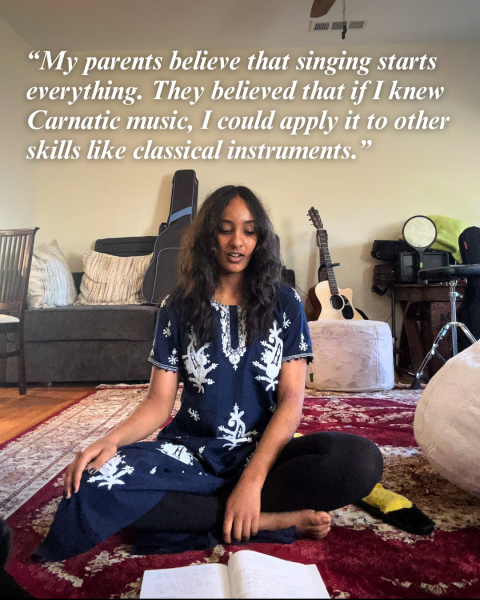
Sophomore Akhila Hosagrahar takes her place onstage, sitting cross-legged in her colorful salwar, a dress-like garment. A sitar, an Indian stringed instrument, buzzes behind her as she begins to belt out a raga, skipping between dozens of notes. She’s been practicing “Saraswati Namosthuthe,” a prayer to the Hindu goddess of wisdom, for weeks.
Hosagrahar’s love for singing came from family — her grandmothers on both sides are singers and her father plays nine different instruments. They inspired her to start learning Carnatic music, a type of Indian classical music, in third grade.
“My parents believe that singing starts everything,” Hosagrahar said. “They believed that if I knew Carnatic music, I could apply it to other skills like classical instruments.”
Hosagrahar’s first instructor strictly adhered to traditional teaching styles from India. During her first lesson, her teacher simply told her to start singing when she barely knew how. Initially intimidated, Hosagrahar was forced to adapt to the heavy workload of learning new songs and techniques, which has taught her responsibility and organization.
“It was a big adjustment from my teachers at school, who were chill,” Hosagrahar said. “But now that I’m older, it’s helped me handle singing better, and I’m actually motivated to do it.”
Overcoming stage fright developed Hosagrahar’s confidence. When she was 10 years old, her parents ushered her to the stage during Dasara, an Indian festival celebrating good over evil, to sing in front of a crowd of 30 people. Completely caught off-guard, she froze. A short bhajan, or religious song, passed through her lips rather than one of the more complex pieces she knew by heart.
“That’s when I realized that I wasn’t ready to sing until I could sit up straight and project,” Hosagrahar said. “I needed to have more confidence.”
To build that confidence, Hosagrahar practiced in front of friends and family, and at more festivals and during prayers. On visits to her family in South India, she bonded with her grandparents over their love for music.
“I go to my grandparent’s flat and sing for them,” Hosagrahar said. “It’s a great way for my family to come together.”
Six months ago, Hosagrahar was accepted into a more challenging and selective singing academy: the Sri Rama Lalitha Kala Mandir School of Fine Arts. Before her audition, she practiced her best songs for months, hoping to impress her future instructor.
“It was the first time Carnatic music was a stressor in my life,” Hosagrahar said. “Before that, it was a hobby. After the audition, I realized I needed to focus if I wanted to improve.”
At the academy, Hosagrahar practices alongside more advanced singers. She concentrates on just one song a month to perfect every note, pronunciation and gamaka, a type of controlled vibrato.
In the future, she hopes to complete her arangetram, a concert and ceremony where a singer is celebrated for their many years of work.
“As I get older, music has been a great way for me to get my mind off grades, work and in the future, college apps,” Hosagrahar said. “It would be great to do my arangetram sometime in college. But if I don’t, I still have a skill set that helps me relax after school.”