














Oscar Chung coasts through his commute on a skateboard
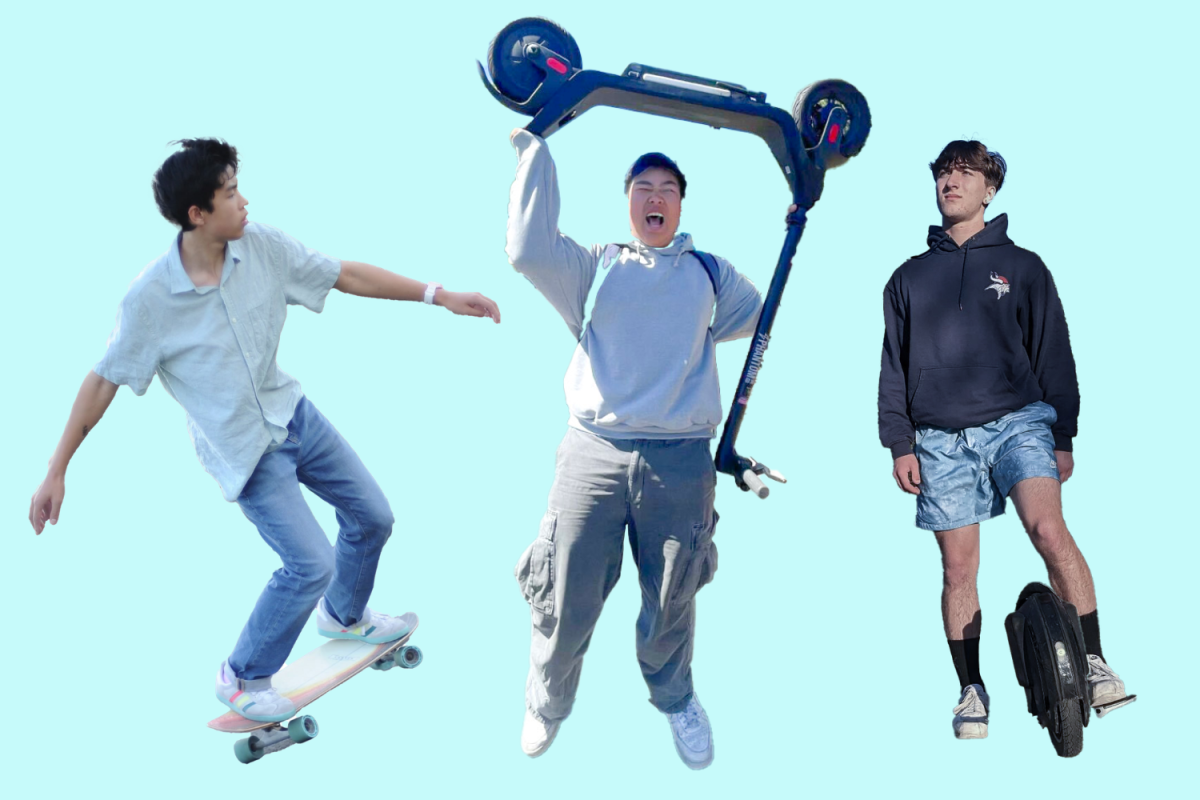
The rhythmic click-clack of wheels gliding over asphalt fills the air as sophomore Oscar Chung pushes off the pavement, his skateboard rolling smoothly beneath him. With a few quick turns and gentle swerves down neighborhood streets, he makes his way to school.
For Chung, getting to school has never been limited to a singular routine. On some days, he walks, bikes or gets dropped off. But on others, skateboarding makes his normal commute relaxing and intimate, allowing him to break away from the struggles of more common transportation.
“Biking feels stressful, walking feels slow and driving is a little bit boring,” Chung said. “So I thought it would be fun to try skateboarding.”
Skateboarding has always been a part of Chung’s life. Whether it was a longboard or a regular skateboard, he grew familiar with skateboarding when his father taught him at eight years old. More recently, he bought a Surf Skate online, a specialized board originally designed to help surfers train on land by mimicking the feeling of riding waves. With unique trucks — which control steering — that allow for more fluid turns, the board makes the ride feel natural for Chung.
Chung started skateboarding to school in March. At first, he was hesitant, unsure of how others might react. However, students showed little surprise and quickly accepted it as a part of his routine.
“I didn’t want people to think I was a poser,” Chung said.
Still, skateboarding to school requires caution. When dealing with steep inclines, busy roads or areas heavy with bikes and cars, safety remains a priority. Chung is flexible with his commute options and doesn’t choose skateboarding on days he wakes up late or tired.
Beyond transportation, skateboarding has grown into a hobby that Chung enjoys in his free time. On days when he feels relaxed or has extra energy, he rides up and down the street, practicing turns and developing his skills.
“I can do basic pumping and bottom turns,” Chung said. “I’d really like to be able to slide and do cutbacks in the future.”
Aerik Turkal finds balance on one wheel
The first time sophomore Aerik Turkal rode to school on a one-wheeled electric board, heads turned. Students watched him glide down the street, gliding effortlessly among a sea of cars and bikes.
Turkal rides a OneWheel, a motorized skateboard with a single large wheel in the center. He stands on either side of the wheel, leaning forward or back to move and control his speed. The board can reach faster speeds than a bicycle, making it a compact and convenient way to travel — but also one-of-a-kind.
Turkal’s mother taught him how to use the OneWheel last year, and he learned naturally with little practice. Riding the OneWheel made Turkal feel unique, adding a small spark of excitement to an otherwise ordinary routine.
“I liked the looks that I got from people,” Turkal said. “It’s like, ‘Oh my god, what is that?’”
Students frequently stop Turkal to ask questions about how the OneWheel works, or if they can try it themselves. He typically declines, both for their safety and to avoid potential damage to the board.
Despite these concerns, Turkal continues to use the OneWheel — even if just in his neighborhood — and finds other ways to get to school, such as biking. Considering his experience with non-traditional modes of transportation, Turkal encourages other students to also try something different for their commute.
“It would probably reduce your carbon footprint since you’re not driving to school,” Turkal said. “You would definitely get people to see it, and maybe you could start a fad.”
Daniel Zhou electrifies his ride to school
Between the haze of cars, bikers and pedestrians, sophomore Daniel Zhou effortlessly cruises through the commotion on his Phantom e-scooter. His rechargeable electric scooter zooms from 15 to 25 miles per hour — faster than most bikers.
Zhou’s older brother introduced him to e-scooters three years ago. The first time he stepped on, the sudden acceleration and smooth glide were exhilarating. He quickly started using it instead of biking. Why tire himself out when he could effortlessly glide past bikers and pedestrians with no effort?
“After using the e-scooter a few times, biking just seemed unnecessarily tiring,” Zhou said. ‘It didn’t make sense to go back.”
For Zhou, using an e-scooter now is primarily about convenience, but that initial thrill hasn’t entirely faded. The scooter is smaller and more agile than a bike. Zhou can easily build momentum and slip ahead of clusters of students, avoiding traffic bottlenecks that can form right before school starts. Even through the noise and congestion, the ride feels controlled.
“I don’t have to worry as much about slow riders or running late,” Zhou said. “It honestly feels pretty serene compared to what’s around me.”
The only downside of an e-scooter that Zhou identifies is having to charge it, something he doesn’t always remember to do. Still, most brands are reliable when low on battery, and the e-scooter remains a convenient way to get outside for Zhou, whether it’s for going to school, traveling to friends’ houses or going on fun rides by himself.
“It’s great to ride it around for fun if you like being outside,” Zhou said. “I’m more of an indoor person, but it makes me enjoy the outdoors.”