














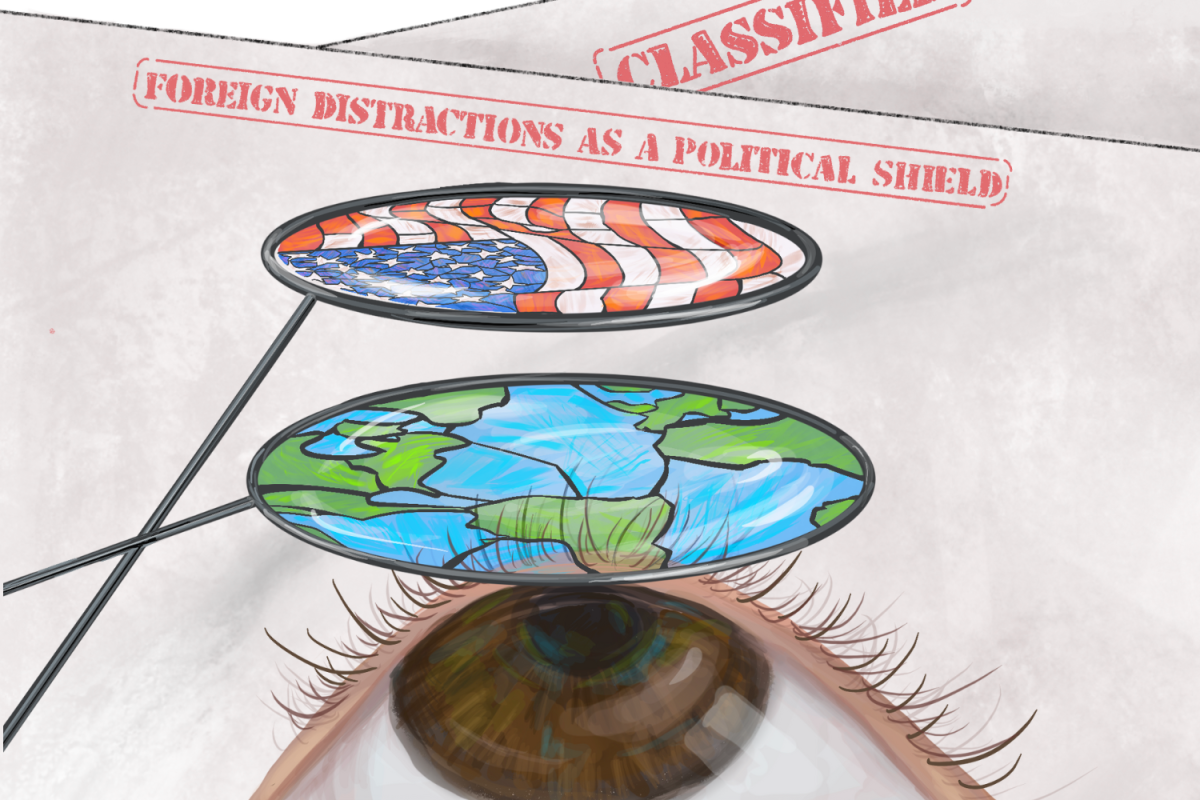
- The “wag the dog” theory explains that political leaders engage in foreign conflict in order to distract the public from a domestic crisis or scandal.
- The “wag the dog” theory has been applied to recent political events including the bombing of Venezuela, which has been criticized as being a method to distract the public from the Epstein files.
- In order to certify the “wag the dog” theory there must be strong direct evidence, such as internal communication.
Part of being a successful politician is knowing how to control public opinion and attention. Often, this can be taken to the extreme — starting foreign wars or major domestic conflicts just to divert scrutiny from a scandal. Recent United States military actions abroad have led some to ask: Is this happening right now?
“When actions are taken without sufficient explanation or context, they can be perceived as attempts to distract,” social studies teacher Mike Williams said.
One name for political distractions is “wagging the dog,” coined in the late 1800s. With this approach, political leaders engage in diversion tactics, such as war, to control public response. The tail, an unimportant event, captures the attention of the dog, which represents the public. The term rose to prominence in the 1997 movie “Wag the Dog,” in which a fabricated foreign conflict is used to distract voters from a presidential scandal shortly before an election. Following the film’s release, observers drew comparisons between its storyline and real world political events, including the Clinton-Lewinsky scandal.
However, timing alone cannot prove biased intentions. Major political moves are often planned over a span of months or years. Only strong direct evidence, such as internal communications and testimonies, elevate the “wag the dog” theory from a conspiracy theory to a real scandal.
“For example, when Bush invaded Iraq, it was to pursue specific strategic interests in the region,” San José State University political science professor Robert Ovetz said. “It was not due to the ‘wag the dog’ effect, because the 9/11 attack became the pretext for war although Iraq had nothing to do with it.”
The Clinton-Lewinsky scandal involved an affair between then-U.S. President Bill Clinton and White House intern Monika Lewinsky. Early allegations were publicly denied by both Clinton and Lewinsky. However, after evidence confirmed the relationship, Clinton admitted to the affair before a jury. Following reports detailing Clinton’s relationship with Lewinsky, the House of Representatives voted to begin an impeachment inquiry, which was later considered by the Senate.
On Dec. 19, days after the House of Representatives accused Clinton of committing “high crimes and misdemeanors,” he ordered airstrikes against Iraq, citing its refusal to cooperate with the United Nations’ weapons inspectors as the motivation. The timing drew criticism from several members of Congress, who accused Clinton of using the air strikes to distract from impeachment proceedings. Others defended his decision as justified to ensure national security.
“Some people argued those actions were meant to distract from impeachment, but that interpretation has always been contested,” Williams said.
Another related concept is the “rally round the flag” effect, where public support for political leaders increases during periods of national crisis. During these moments, citizens often unite behind their government, driven by risk of external threat, prioritizing collective identity over political disagreement during emergencies. united by a common threat.
This effect was evident after President George W. Bush’s nationwide address in response to the Sept. 11 terrorist attacks. Bush’s approval rating jumped from 51% on Sept. 10 to 90% Sept. 22, according to a poll conducted by Gallup. Although the surge gradually declined, Bush’s approval rating remained elevated at 60% in November 2002.
“The population is being distracted away from the domestic crisis,” Ovetz said. “What is the issue that now gets dropped? That’s no longer being reported on. That conversation changes, and the focus changes.”
In mid-December 2025, the Department of Justice released an initial set of documents related to convicted sex offender Jeffrey Epstein under the Epstein Files Transparency Act. However, the release drew criticism from lawmakers and the public for containing extensive redactions and omitting millions of pages of potential evidence. They sparked questions about accountability among powerful figures connected to Epstein’s sex trafficking network, particularly due to redactions that obscured the identities of some individuals.
The release of the documents occurred amid rising tensions between the U.S. and Venezuela. Just weeks later, on Jan. 3, the U.S. launched a large-scale military operation against Venezuela, codenamed Operation Absolute Resolve, that resulted in the capture of Venezuelan president Nicolás Maduro and first lady Cilia Flores on narco-terrorism and drug trafficking charges, according to U.S. officials. The timing prompted some observers to question whether the decision was an attempt to deflect public criticism. Some critics even argue that the Venezuela operation may have been a deliberate attempt to redirect media attention from the Epstein files.
“Before the Venezuela operation, Epstein files would pop up on my feed all the time, but now the Venezuela operation shows up all the time,” freshman Debansh Kumar Pal said. “Out of 10 political videos I get in my feed, three are about Epstein, and seven are about Venezuela.”
From the Clinton Administration to the Epstein files, observers have noted recurring patterns in which major external actions, like military operations, coincide with internal political controversies. Whether intentional or not, foreign conflicts have the immutable power to shift attention away from domestic issues.
“Usually all the knowledge and beliefs that people have come from the kind of media they see and the perspective they have most ready access to,” freshman and Politics Club member Coco Xu said. “If the government influences the media to focus exclusively on an issue that takes away attention from their own scandals, then of course the public isn’t going to pay attention to the government anymore.”