













Over a decade ago, Debra Rojas, the daughter of labor rights activists, made a now-deleted post on a Facebook page for United Farm Worker veterans preparing to celebrate Cesar Chavez Day: “Wake up, people. This man u march for every year molested me and many, many other young girls.” Her message was immediately drowned out by a wave of people accusing her of tarnishing the reputation of their entire movement. It took many years — when a New York Times investigation detailed Chavez’s abuse of multiple women this March — for the horrors that Rojas and other women endured at the hands of Chavez to finally be exposed.
The public’s lionization of Chavez within the farmworkers’ movement sheltered him from criticism and prevented sooner investigation of his actions. His legacy proves that social justice movements should not be built around a single person when so many people are involved. Instead, all contributions must be valued.
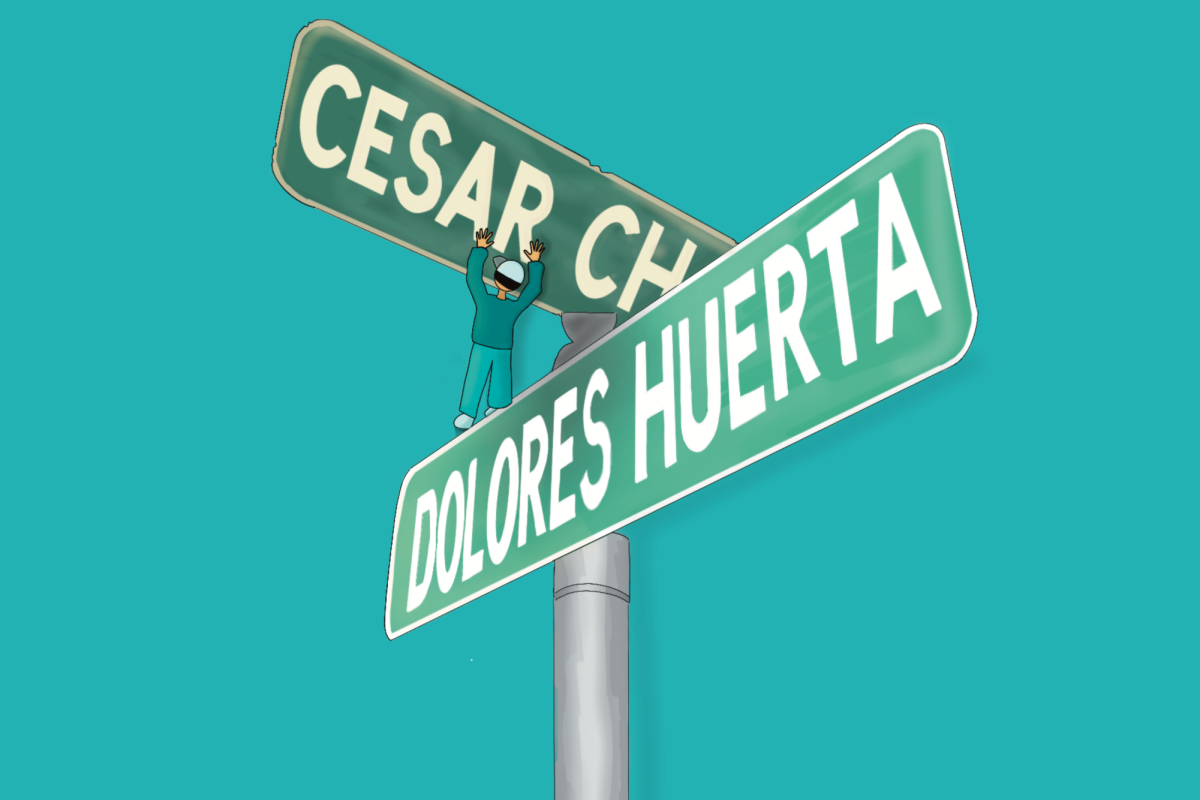
Chavez was masked by a facade of global recognition that elevated him as the face of the farmworkers movement. As the co-founder of the United Farm Workers labor union, he was remembered for organizing nonviolent boycotts to advocate for the rights of farmworkers. Former president Bill Clinton awarded him a Presidential Medal of Freedom, and former president Joe Biden exhibited a bronze bust of Chavez on his desk in the White House. His name is proudly plastered on street signs and in history textbooks.
“Prior to hearing about the sexual abuse, I recognized him as someone who made a good change,” senior and Spanish Honor Society president Alessandra Wong said. “He had a really big influence on the Hispanic community because he gave them a voice, and he showed that Hispanic leaders can rise up and that the Latino population as a whole is stronger together than apart.”
Although Chavez was not the sole founder of United Farm Workers, the union’s power dynamics revolved around him, which attracted positive media coverage while hiding his horrific acts. Many victims say they were pressured to remain silent for decades to preserve his public image. Labor leader Dolores Huerta, who was abused by Chavez, co-founded the organization yet was not awarded nearly the same level of recognition. In centering a movement around one figure, the contributions of everyone fail to be honored.
“In anything, especially a social movement, it takes a village,” said Angelica Esquivel, professor of Chicanx and Latinx studies at De Anza College. “Recognizing all of those pieces just reminds us of the humanity of everyone who was involved. My hope for the future is that we have those recognitions written in textbooks.
In fact, thousands of people dedicated themselves to improving the lives of farmworkers. Huerta negotiated the first-ever bargaining agreement with an agricultural business to secure better working conditions for farmworkers. Other female activists, like Jessica Govea and Elaine Elinson, fought sexism within unions and managed boycotts overseas that helped launch the first contracts for farmworkers. Filipino labor rights activist Larry Itliong led over 1,500 Filipino farmworkers to demand higher wages and better working conditions in a 1965 strike against Delano grape growers. He started organizing farmworkers in the 1930s, long before Chavez. Unfortunately, Chavez’s celebrity status has caused the contributions of these people and thousands of others to be forgotten or never learned about.
“There are so many local figures that are central to the stories of the farmworkers movement,” said Dr. Ella Diaz, professor of Chicana and Chicano studies at San José State University. “When we step back from the hero, we see hundreds and thousands of people that are moving this important social justice movement forward. Hopefully, we’re understanding that it’s not so much that we need to plug in a new figure, but maybe we need to start telling the larger stories and using other sources to multiply and create a space of people where there has only been an individual.”
Chavez is a prominent example of the troubling historical trend of heroizing imperfect — often male — leaders. Founding father Thomas Jefferson famously penned “all men are created equal” in the Declaration of Independence, yet owned more than 600 slaves in his lifetime. A federal holiday commemorates explorer Christopher Columbus’ arrival in the Americas, yet he sanctioned brutal violence against indigenous populations. Idolizing figures who have done harm is an injustice to the victims they’ve hurt.
“It’s important for these social figures to be brought back down to earth and to humanize them and make sure that they don’t have an excessive amount of power,” Wong said.
Holding influential figures accountable does not have to negate the positive contributions they’ve made. Chavez’s advocacy undoubtedly brought about lasting changes for farmworkers. Although it is reasonable to look up to someone that embodies the values of a movement, the problem lies in using them as a figurehead for that entire movement.
“This is a movement that is a lot bigger than one man, and you can easily talk about this movement without even mentioning his name,” Spanish teacher Michael Esquivel said. “This is a good time to bring up names of people who aren’t household names. Cesar Chavez is a household name, but what about all the other people that did make this movement happen?”
For centuries, the Latin phrase “e pluribus unum,” meaning “out of many, one,” has remained the motto of the United States. It represents the ideal of combining multiple backgrounds and perspectives to tell a unified tale. Across generations and cultures, powerful stories within the farmworkers movement were shaped by workers, journalists, students, teachers and organizers who envisioned a better future and gave their all to achieve it. They are told through the experiences of resilient people who refused to give up their fight to better the lives of peers and generations to come. Their voices mold together to tell something beyond the scope of one man.
“Maybe it’s not about falling silent about the historical figure that has been positioned as shorthand for an entire movement, and maybe it’s not about simply replacing one with another,” Diaz said. “Maybe it’s about rethinking this approach altogether. How can we tell these histories in a more collective, more people’s way? I would argue that’s incredibly American. How can we take the multiple voices and create, instead of a singular heroic memory, this much richer multi-vocal experience?”