

















- Aeronautics Club launches model rockets at the football field as new final project.
- Despite multiple delays, five rockets launched successfully on April 2.
- The American Rocketry Competition is the Aeronautics Club’s more advanced competition for aspiring rocketeers.
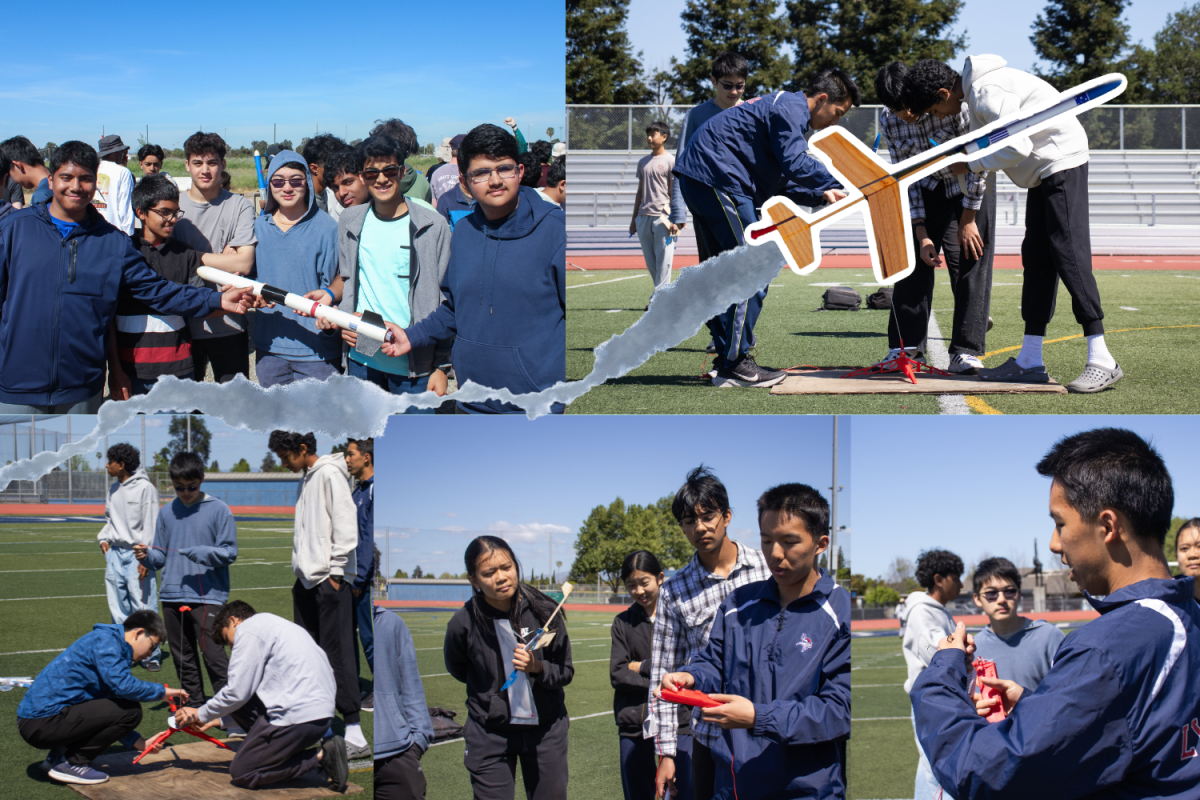
The Aeronautics Club launched six model rockets on April 2. The end-of-semester project took place over three weeks from late January to mid-February. During this period, members crafted model rockets and attended launch-preparation workshops every Thursday lunch.
“We wanted a workshop where all the members could participate in building their own rocket,” senior and Aeronautics Club president Richard Li said. “I felt like it would be a lot more fun and come with more action.”
On launch day, the club moved to the football field under the supervision of Assistant Principal Tara Grande. Members placed their rockets on a cardboard mat and connected them to a remote. Out of the six rockets built, five launched successfully, with some travelling up to 150 feet in the air.
In previous years, the club ran a similar annual event showcasing a single handmade rocket crafted outside of school, then later launched by the officers. This year’s launch provided all club members with a chance to take part.
Officers led all workshops, assisting members in six teams. Each team built one rocket, following printed instructions and using plastic Condor Boost Glider kits and model rocket engines. The kits come with components for a rocket pod and glider, a wooden base, wings and adhesive to glue the glider together.
However, some members found the instructions unclear. Groups also struggled to separate their rocket components from those of other groups.
“Things got mixed up a lot, even if we had our names on them,” sophomore and club member Catherine Jian said. “Another challenge was the glue; it was a Super Glue that either dried out too fast or didn’t dry at all.”
The club also organized one team for the American Rocketry Competition to plan and assemble a separate rocket, which can fly up to 1,000 feet. While they usually collaborate with Engineering Club for the annual contest, this year, 10 selected members worked on the club’s individual entry.. Ultimately, they were only 100 feet short of the cutoff to advance to nationals.
“Honestly, since a lot of us were first-years in TARC, we didn’t have a lot of expectations,” junior, secretary and TARC co-captain Miro Maeda said. “It was the first year for Aeronautics as a club independent from Engineering, and I think we did pretty well learning from it. I’m satisfied.”
In coming years, Aeronautics Club hopes to provide similarly flexible events for members with a bigger budget to help expand members’ experience with rocketry.
“Aeronautics costs a lot of money,” Maeda said. “But it’s a fun process, and aeronautics is a bit of a niche field. Hopefully, the club can be a safe space for these aerospace connoisseurs.”