











“Seriously retarded,” President Trump wrote in reference to Gov. Tim Walz of Minnesota in November 2025. Although originally a medical term, the “R-word” has been distorted into a slur used against people with intellectual and developmental disabilities. The recent resurgence of the slur in public discourse, including on high school campuses, is a sign that our society is once again normalizing ableism. As the R-word continues seeping into everyday conversations, we need to be more intentional in rejecting dehumanizing language and holding others — as well as ourselves — accountable for the words we use.
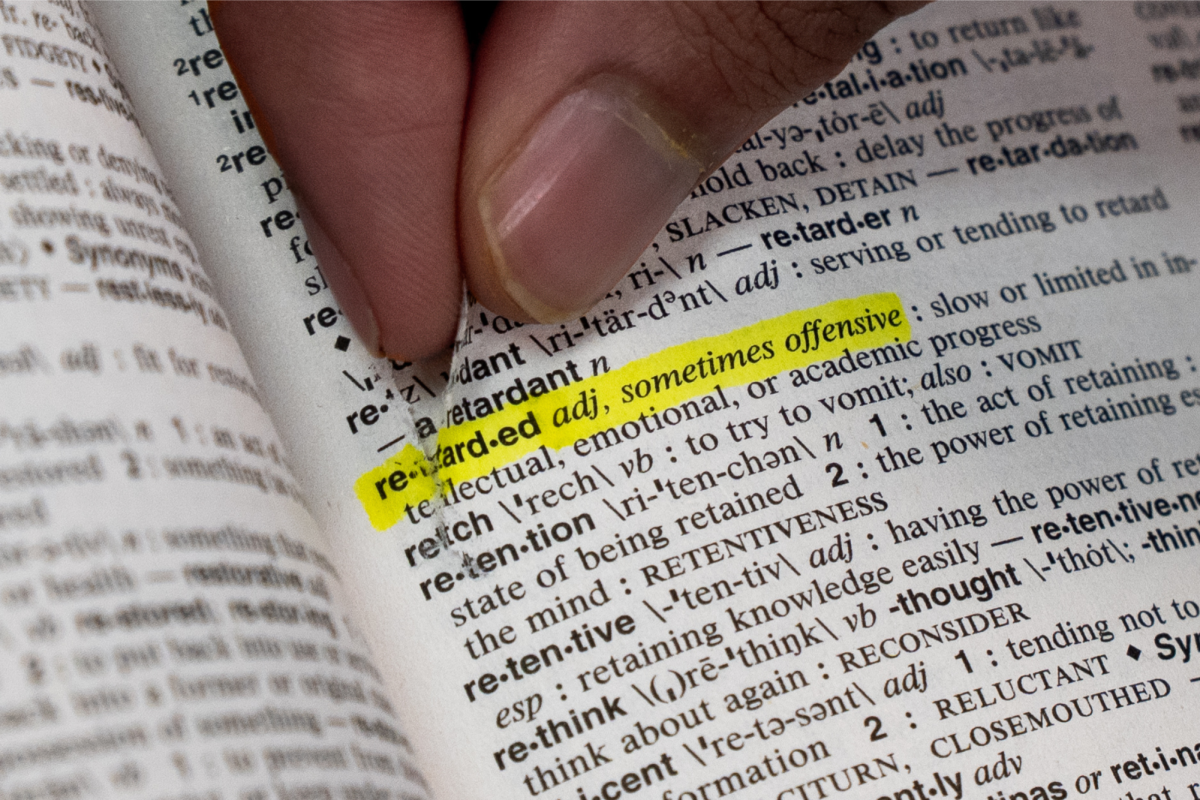
“Mental retardation” was introduced as a medical term in 1845, meant as a neutral replacement for “idiot,” “moron” and “imbecile”: all IQ classifications that society twisted into insults. However, as the term became mainstream, systemic abuse and prejudice gave the R-word a lasting negative connotation. This irony exposes societal efforts to confine those with intellectual disabilities within a single label signifying inferiority. Historic acts further convey how they have been treated unfairly as inferior: they were chained and abused in institutions and forcibly sterilized. This history makes today’s use of the word even more harmful.
The recent increase of the slur is evident everywhere, especially on social media. Harmeet K. Dhillon, the assistant attorney general who oversees the Justice Department’s Civil Rights Division, posted a caption on X under an image of a hat she had knitted: “This hat is an hour behind schedule thanks to influencer retards.” Part of the division’s work is protecting Americans with disabilities, making the comment even more jarring. Supposed role models using degrading language can influence students to follow suit. Thus, people in power need to exercise better judgment, while students should thoughtfully assess the impact their words have in their own communities before speaking.
Even at Lynbrook, the slur can sometimes be heard in casual conversation. Those students may lack knowledge of its harm to marginalized groups. Other times, it is used to ostracize or mock special education students: a scheme intended to stir up reactions. Either way, students should be aware that using derogatory language is never amusing.
“I hear people our age use the word a lot,” senior and Viking Buddies Club secretary Shelby Kim said. “It comes off as really insensitive because they use it as an insult similar to ‘dumb’ or ‘stupid,’ which promotes the stereotype that all people with intellectual disabilities are unintelligent.”
Saying a word emblematic of past — and often present — hatred shapes a discriminatory society. Beyond stopping its use, students must also foster inclusivity.
“A lot of our students are anxious about going on the main campus,” special education teacher James Lohmeier said. “To promote inclusivity, Lynbrook students can recognize that they probably have more in common than what distinguishes them. My mother’s standard line was, ‘if you don’t have anything nice to say, don’t say anything at all.’ Even if you’re having a conflict, don’t call each other names.”
On X, the R-word is used more than 46,000 times daily — an increase of over 2,000% from 2020, proving that ignorance and hatred run rampant in our society. It is common to follow the crowd on social media; it can be difficult to take a stand against derogatory language. Despite this, drawing these lines is important in limiting the spread of hostility.
“When you don’t spend a lot of time with special education students, it’s easy to view them as different from you,” Kim said. “But when you’re actually interacting with them, it becomes a lot easier to realize that they’re just like you. They love doing the same activities and find the same things fun.”
Not only does the resurgence of the R-word perpetuate trends of persecution, it also erases efforts to stop its use. The Spread the Word campaign began in 2009; now, more than 900,000 people have pledged to stop the R-word’s use. In October 2010, President Barack Obama signed Rosa’s Law, requiring “intellectual disability” to replace “mental retardation” in legislation. Such efforts show change is possible, yet they are being undermined as use of the R-word continues. We must confront this by educating ourselves on the word’s history, raising awareness of its detrimental impact and treating people with disabilities with respect.
“People need to actively look for opportunities to connect with the special education community,” senior and Viking Buddies Club co-president Lucia Liu said. “You don’t have to join any special program or club. You can just walk by and say hi to them, or strike up a conversation: introduce yourself and learn more about them. We need to reach outward and be open-minded.”
Words hold so much power. The R-word dehumanizes those with disabilities. Silencing the slur is not enough to stop its spread: we must actively speak out against those who use it. By ensuring the word has no place in society, we form a future where no one has to doubt their worth.