

















- Humans have looked to the night sky for thousands of years.
- Stargazing has never been more accessible.
- The drive to understand the sky is fundamental to human curiosity.
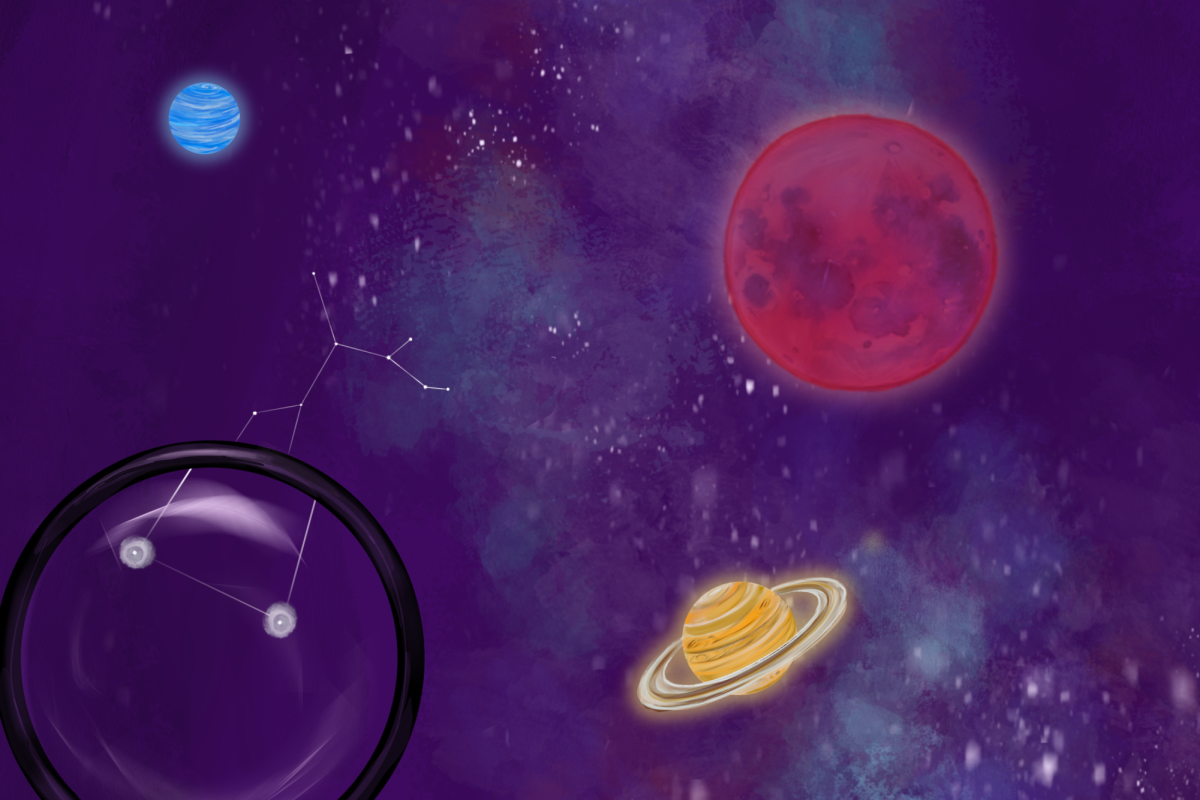
On March 3, millions of people across Asia, North America and Australia will step outside, tilting their heads toward the sky as the moon slips into Earth’s shadow for a total lunar eclipse — an event that takes place roughly every two and a half years. For an hour, the moon will appear fully red, a phenomenon called a “blood moon,” as sunlight filters through Earth’s atmosphere and casts a coppery glow across its surface.
While the spectacle may feel distinctly modern as it is shared through social media, livestreams and photos, humanity has been making sense of the world through the vast night sky for thousands of years. Long before telescopes and space agencies, the movements of the sun, moon and stars shaped how civilizations tracked time, navigated oceans and interpreted their place in the natural world.
“In the ancient world, the sky was there at night,” De Anza College astronomy professor Eric Peterson said. “People tried to make sense of it, tried to understand it and told stories about it. It’s been a part of everyone’s culture throughout history.”
For early societies, understanding the movements of celestial bodies was essential for survival. Knowing when spring would arrive determined when crops could be planted, while predicting the first frost determined when to harvest them. Even without modern forecasts, ancient civilizations learned that constellations appeared slightly earlier each night and returned to the same position after a full year. The sun’s path was a seasonal marker, reaching its highest point in the sky during the summer solstice and its lowest during the winter solstice. Many cultures around the world built large structures, like Stonehenge in modern-day England, to mark key solar events.
As societies grew more complex, timekeeping became more structured. Cultures developed solar, lunar, stellar and lunisolar calendars based on their unique needs. In ancient Egypt, priests timed the heliacal rising of Sirius, the “Dog Star,” to predict the Nile’s annual flooding. Farther west in Mesoamerica, the Maya created dual calendar systems: the vigesimal 260-day Tzolkin calendar was used for ritual purposes, while the solar 365-day Haab calendar was used for civil timekeeping.
Consistent star patterns made the sky an essential tool for navigation, allowing travelers to orient themselves across land and seas without any instruments. To maintain direction, Norse seafarers from Scandinavia relied on the sun’s position during the day, and the star Polaris, located near Earth’s northern rotational axis, at night. Across the Pacific Ocean, Polynesian navigators developed equally sophisticated star-based orientation systems: master navigators often memorized the rising and setting positions of hundreds of stars, giving them the ability to pinpoint their location.
By the 18th century, European and American sailors were using tools such as the sextant, which measured the angle between a celestial object and the horizon to calculate latitude. Combined with star charts and accurate timekeeping devices like marine chronometers, celestial navigations remained central to long-distance sea travel.
“The understanding of what’s happening in the sky was one of the first significant scientific achievements of the world,” Peterson said. “To understand that the sun was at the center of the solar system and that we’re on a ball of rock in space, hurtling around the sun, really transformed humanity.”
The sky also carried profound symbolic meaning for civilizations across the globe. Hausa-speaking communities in West Africa understood the solar eclipse as the sun catching the moon, prompting drumming and prayer. In ancient Mesopotamia, Babylonian priests observed and recorded the movements of celestial bodies in the Enūma Anu Enlil, used to guide kings.
Later, Babylonian astronomers divided the sky into 12 sections, laying the groundwork for what would later become the zodiac. The ancient Greeks then named the zodiac signs after constellations and linking them to specific times of year. By the second century, scholars like Claudius Ptolemy created personal horoscopes, arguing that celestial patterns at the time of birth could predict destiny. During the Middle Ages and Renaissance, monarchs routinely consulted astrologers before making major political decisions. Though today, astrology is often viewed as entertainment or pseudoscience, it continues to attract younger generations searching for clarity.
Despite drastic changes in human civilizations and technology over the course of history, the night sky has remained relatively unchanged. Modern stargazers can still use Polaris to identify the North Pole like the Vikings. Constellations can be identified and their stories shared, in the same way the Greeks did.
“When I look up, I feel connected to my ancestors because we’ve been looking at the same stars all these years,” sophomore Jason Zhang said. “We see the same night sky as people across the world.”
For most of human history, clear access to the sky was often limited. Telescopes were expensive and astronomy was the domain of professionals. Today, apps like Stellarium and SkySafari allow anyone with a smartphone to identify stars. Astrophotography has exploded as a hobby: images of nebulae that once required professional equipment can now be produced with a DSLR camera and free stacking software. Social media has made space exploration more popular than ever, bringing worldwide attention and anticipation to rare celestial activities.
“You can get something better than Galileo’s telescope for less than $100,” Foothill College astronomy professor Geoff Mathews said, “It’s possible to get a close view of nebulae and globular clusters without much investment.”
The drive to make sense of the sky has never stopped accelerating. Commercial spaceflight has made spacefaring more tangible, with NASA’s Artemis program aiming to return humans to the moon as a stepping stone to Mars.
At the same time, the long-lasting tradition of reaching for the stars is slowly becoming lost in the midst of urbanization. With an estimated 80% of the world population affected by light pollution, the stars that once guided calendars, ships and myths are becoming harder to see. Not only do they lose a window into nature, studies have shown that the loss of opportunity to see the starry night sky has a direct impact on scientific curiosity.
No matter how advanced society becomes, the same stars are still shared. The eclipse can now be explained through celestial mechanics and atmospheric physics, but it will also inspire the same awe that moved civilizations to build monuments, chart oceans and record omens.