

















- In the 2023-24 school year, intensive construction and utility work resulted in the trees’ removal around the 300s wing.
- Following renovations to the 100s, 200s and 300s wings, new trees on campus are replacing those that were cut down.
- New planters with young trees and drought-resistant plants have returned on campus to add to Lynbrook’s vibrant landscaping.
During the 2023-24 school year, trees near the 300s wing were cut down in preparation for campus renovations. Two years later, new trees have returned to campus as part of ongoing construction.
Utility work necessitated the trees’ removal: in consultations with an arborist, administrators learned that the construction would permanently damage the tree roots and potentially result in falling trees. To preserve campus safety, they made the decision to cut down the trees. The removal allowed Lynbrook’s fire line and domestic waterway to be redone, changing it from one pipe to two separate systems.
“The administration asked, ‘Can we save the trees and what would it look like if we tried to save them?’” Assistant Principal Tara Grande said. “We pushed back to make sure that there were no alternative solutions. Once we were told that there’s no other possibility, we had to go with it.”
To mourn the loss of the familiar greenery, some students left sentimental notes at the base of the trees and duct-taped posters of the Lorax on remaining stumps. Former Principal Maria Jackson also posted photos of the trees’ memorials to grieve the removal along with the Lynbrook community.
“Two things can be true: we can miss the trees, but they had to go,” Grande said. “We weren’t trying to be disrespectful; we just didn’t have a choice. It was very hard for us to take them down, especially when you see that our new trees are going to take a while to get that big.”
In the 2025-26 school year, trees have arrived back on campus. Following renovations of the 100s, 200s and 300s wings, the construction crew replaced the previously square-shaped planters near the 300s wing with fewer but longer planters.
“Keeping a similar kind of layout was nice,” junior Jaclyn Chiu said. “Since the planters are shorter now, I’ve noticed that sometimes they get in the way when people are walking. People walk along the bushes or the plants and may happen to step on them.”
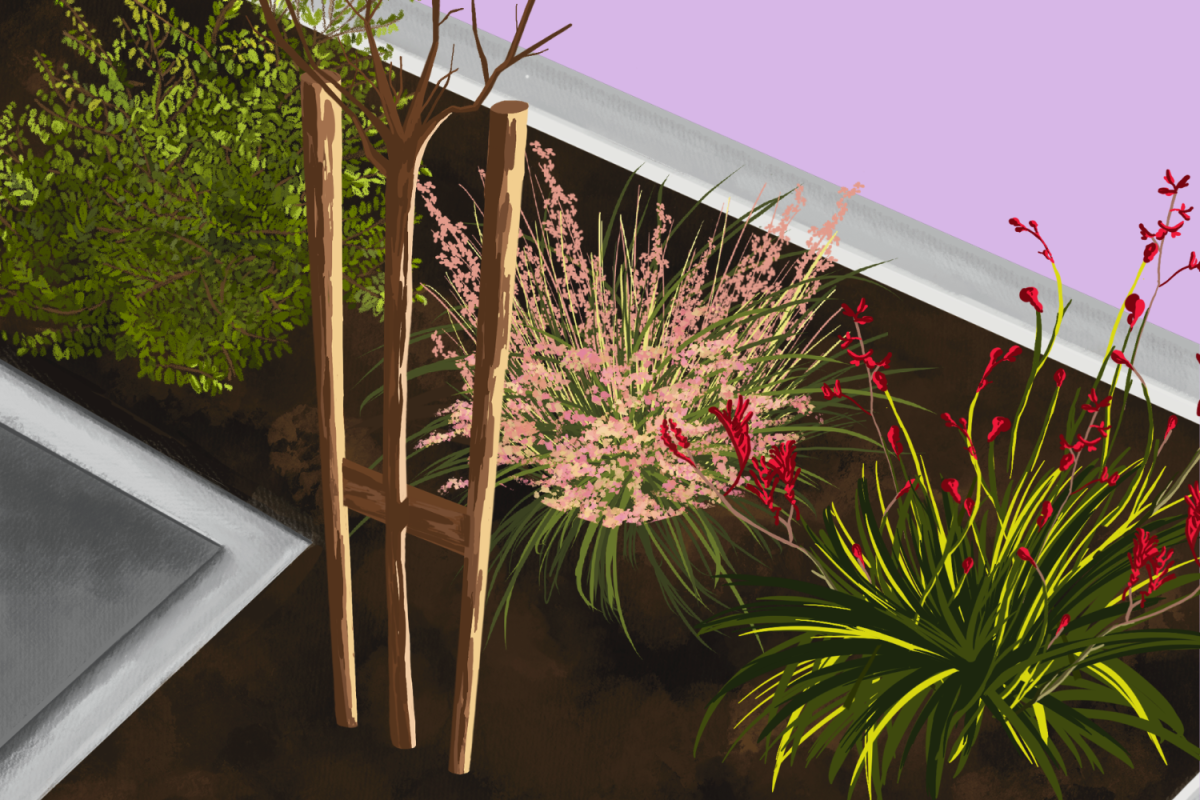
The plants were chosen to create a green campus with drought resistance. The kangaroo paw, a drought-tolerant Australian perennial, along with shrubs of Chinese fringe flowers, are set to add pops of red and pink among the green trees.
With most of the trees still young, the benefits of the previously towering greenery have yet to return. The new saplings do not provide the same level of cover, shelter or shade on a hot day. Some are still supported by wooden poles, their planters protected by caution tape to prevent students from trampling the mulch and disturbing their growth.
While the new trees still have a long journey ahead of them, they are a step forward in restoring vibrant foliage on campus.
“Plants make the school environment more lively and send an important message about sustainability on campus,” said Michael Tang, sophomore and Lynbrook co-lead for the FUHSD Climate Collective. “Having greenery is something that we should strive to have in our community.”